
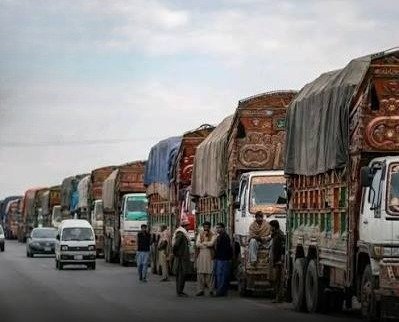
The Goods Transporters Alliance and the government have agreed to establish a Joint Monitoring Committee to address issues faced by the transport industry, particularly in dealing with customs authorities and other relevant government departments.
The agreement was reached after two days of negotiations between the government and the All Pakistan Goods Transporters Alliance in Islamabad. The discussions focused on immediate and long-term measures to resolve operational difficulties faced by goods transporters across the country.
The concluding session was chaired by Federal Minister for Communications Abdul Aleem Khan, who is also the convener of the committee constituted by Prime Minister Shehbaz Sharif to address the transporters’ concerns.
Federal Minister for Maritime Affairs Junaid Anwaar also participated in the meeting through a video link. He assured representatives of the transport sector that his ministry would extend full cooperation on issues related to maritime transportation and port operations.
The five-hour concluding meeting was attended by the Federal Secretary for Communications, Chairman of the National Highway Authority (NHA), Inspector General of the Motorway Police and senior officials from relevant government departments.
Representatives of the All Pakistan Goods Transporters Alliance, including Malik Shehzad Awan, Nasir Jafri, Owais Chaudhry, Qamar-uz-Zaman, Bakhtawar Khan and Shabar Malik, also participated in the discussions.
Joint Monitoring Committee To Oversee Customs Issues
Under the agreement, a Joint Monitoring Committee comprising representatives of Customs authorities and goods transporters will be established. The committee will monitor issues between transporters and customs officials and work toward resolving them through coordinated measures.
The government also reviewed proposals submitted by transporters regarding customs procedures and other operational challenges.
Senior officials of the Federal Board of Revenue (FBR) presented recommendations on these proposals during the meeting. Officials from port and shipping authorities, as well as the Karachi Port Trust (KPT), also briefed participants on matters related to cargo movement and port operations.
The discussions are expected to provide a platform for transporters and government departments to resolve complaints more efficiently while improving coordination across the supply chain.
The government also considered short-term measures to provide immediate relief to transporters, alongside longer-term reforms aimed at improving the overall freight transportation system.
State-Of-The-Art Weigh Stations Planned
One of the major issues discussed during the meeting was the functioning of weigh stations on national highways and motorways.
Abdul Aleem Khan directed authorities to address complaints raised by transporters regarding weigh stations on a priority basis. He said state-of-the-art weigh stations with minimal human intervention would be established on all motorways.
The planned system is aimed at reducing manual interference and improving transparency in the weighing process. Automated facilities could also help reduce delays for freight vehicles and ensure more consistent enforcement of weight regulations.
Transporters welcomed the minister’s efforts and appreciated the government’s engagement with their representatives.
The meeting also discussed the axle-load issue, which has remained an important concern for the goods transportation industry.
Transporters Support Uniform Axle-Load Policy
During the negotiations, transporters expressed support for the government’s policy on axle-load regulations. However, they stressed that the issue should be controlled at its source through a uniform policy.
A consistent axle-load mechanism across the country could help prevent differences in enforcement between various routes and authorities. It could also improve road safety while providing greater certainty for transport operators.
Officials from the NHA and Motorway Police participated in discussions concerning road infrastructure, enforcement and other issues affecting freight transportation.
The government also reviewed proposals involving the NHA and Motorway Police as part of its broader effort to address concerns raised by the transport sector.
Petroleum And Port Issues Also Discussed
The negotiations also covered matters related to the petroleum sector. Senior officials from the Ministry of Petroleum held detailed discussions with representatives of the transporters.
Fuel-related issues remain important for goods transport operators because changes in fuel costs directly affect freight charges, operating expenses and the prices of goods transported across the country.
Maritime-related matters were also discussed in the presence of officials from port and shipping authorities and the Karachi Port Trust.
Junaid Anwaar assured the transporters of his ministry’s cooperation in resolving issues linked to maritime transportation and port operations.
The government’s engagement with the transporters comes as authorities seek to improve the efficiency of Pakistan’s logistics and freight movement system.
The establishment of the Joint Monitoring Committee could provide a structured mechanism for addressing complaints and monitoring progress on agreed reforms.
The two sides are expected to continue consultations on the remaining issues, with the government focusing on measures that can improve coordination among Customs, FBR, NHA, Motorway Police, port authorities and transport operators.