
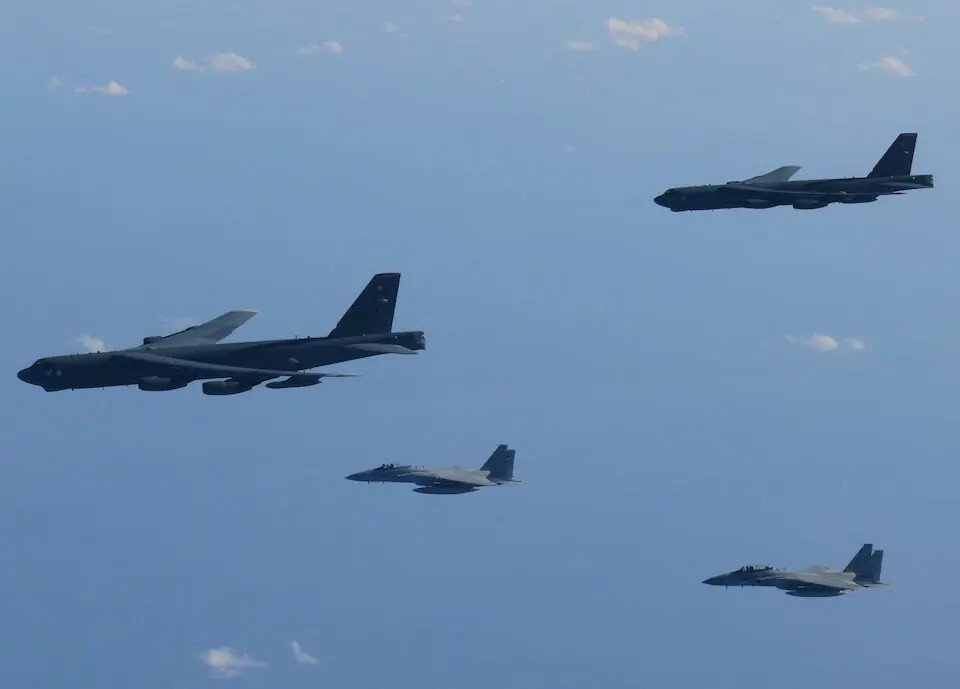
TOKYO – Two U.S. Air Force B-52H Stratofortress bombers, capable of carrying nuclear weapons, conducted a high-profile joint flight with Japanese fighter jets over the Sea of Japan on Wednesday, Tokyo announced Thursday, in the clearest military response yet to recent Chinese and Russian aerial and naval activities around Japan and South Korea.
The mission saw the nuclear-capable bombers escorted by three cutting-edge F-35A stealth fighters and three F-15J air-superiority jets of Japan’s Air Self-Defence Force. Japan’s defence ministry described the exercise as a demonstration of “strong resolve to prevent any unilateral attempt to change the status quo by force.”
The flight marks the first U.S. bomber deployment in the region since China launched large-scale exercises last week and follows Tuesday’s joint Chinese-Russian strategic bomber patrol over the East China Sea and western Pacific. Separately, Japan accused China’s Liaoning carrier group of illuminating Japanese patrol aircraft with fire-control radar south of Japan – an action Beijing denied, claiming Japanese jets had endangered its operations.
Washington condemned the radar incident as “not conducive to regional peace and stability” and reiterated its “ironclad” commitment to Japan’s defence.
South Korea’s military also scrambled fighters on Tuesday when Chinese and Russian aircraft entered its air defence identification zone.
Analysts link the surge in tensions to remarks last month by Japanese Prime Minister Sanae Takaichi suggesting Tokyo could play a direct role in any Taiwan contingency – statements that infuriated Beijing, which views Taiwan as a breakaway province.
With Japan hosting the largest overseas concentration of U.S. forces, including the USS Ronald Reagan carrier strike group, the latest bomber mission underscores deepening trilateral coordination among Washington, Tokyo, and Seoul amid escalating great-power rivalry in the Indo-Pacific.