
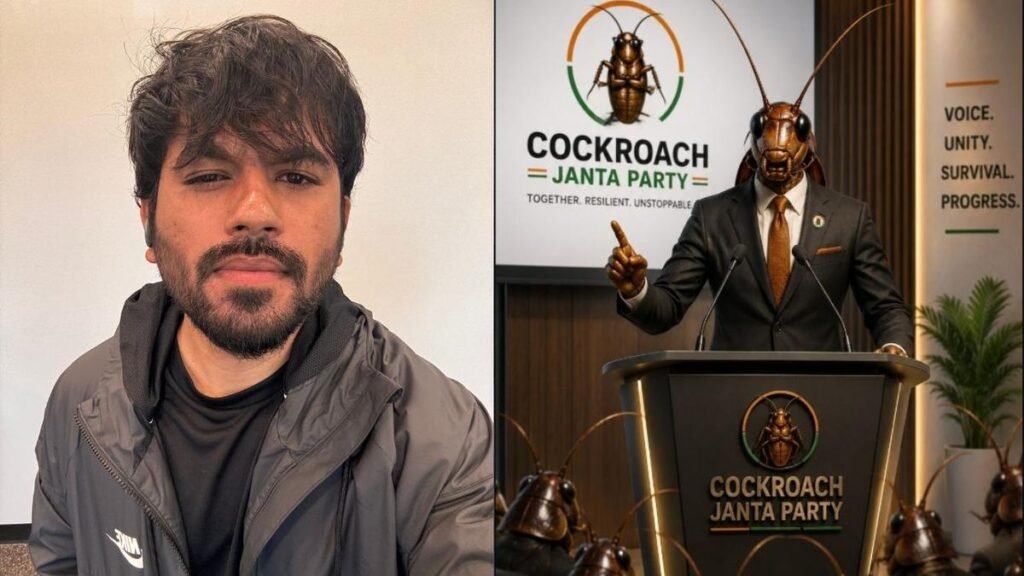
New Delhi, May 22, 2026 – In a stunning display of digital-age activism, the Cockroach Janta Party (CJP) has emerged as one of the most talked-about political phenomena in India. What began as a tongue-in-cheek response to controversial remarks by Chief Justice Surya Kant has ballooned into a massive youth movement boasting millions of followers across social media platforms within days of its launch.
Founded on May 16, 2026, by Abhijeet Dipke, a 30-year-old Boston University student and former Aam Aadmi Party strategist, the CJP cleverly reclaims the “cockroach” label thrust upon frustrated unemployed youth. The party’s motto – “Voice of the Lazy & Unemployed” – and its playful eligibility criteria (unemployed, lazy, chronically online, and professional ranters) have struck a chord with millions of young Indians grappling with joblessness, education scams, and systemic neglect.
The spark came on May 15 when Chief Justice Surya Kant reportedly referred to certain agitators as “cockroaches” attacking the system. Though the judge later clarified he targeted fraudsters, the remark ignited widespread outrage among youth already battling 40% graduate unemployment rates and scandals like the NEET-UG paper leak. Dipke seized the moment, launching a Google Form and social media handles that quickly amassed over 10-15 million Instagram followers, reportedly surpassing even the ruling Bharatiya Janata Party (BJP) in some metrics.
The party’s platform blends sharp satire with serious demands. It calls for free world-class education, universal healthcare, clean air, and accountability for ministers like Dharmendra Pradhan over examination irregularities. Rejecting traditional “freebie” politics, the CJP manifesto emphasizes investments in productivity, skill development, and transparent governance. Its ideology is described as secular, socialist, democratic, and proudly “lazy” – a jab at stereotypes labeling youth as unmotivated.
Social media has been flooded with memes, satirical videos, and protest anthems featuring cockroach symbols. The movement’s X (formerly Twitter) handle faced temporary withholding in India, only to return stronger with new accounts and the defiant slogan “Cockroaches Are Back.” This censorship attempt has further boosted its popularity, with supporters viewing it as proof of establishment fear.
Political reactions have been swift and divided. Opposition figures and activists like Prashant Bhushan have praised the CJP for channeling genuine youth anger. Meanwhile, BJP leaders have dismissed it as an opposition-backed gimmick aimed at destabilizing the government. Some analysts question the founder’s background and US location, while others see it as authentic grassroots frustration.
Despite being unregistered and satirical, the CJP shows signs of evolving beyond memes. Virtual rallies, policy discussions, and membership drives suggest a desire for real impact ahead of future elections. Critics warn that sustaining momentum without formal structure will be challenging, but supporters argue its strength lies in staying decentralized and humorous.
As India’s youth unemployment crisis deepens and living costs rise, the Cockroach Janta Party represents more than a joke – it has become a powerful outlet for a generation demanding to be heard. Whether it fades as another viral trend or transforms Indian politics remains to be seen, but for now, the cockroaches are marching loudly.