
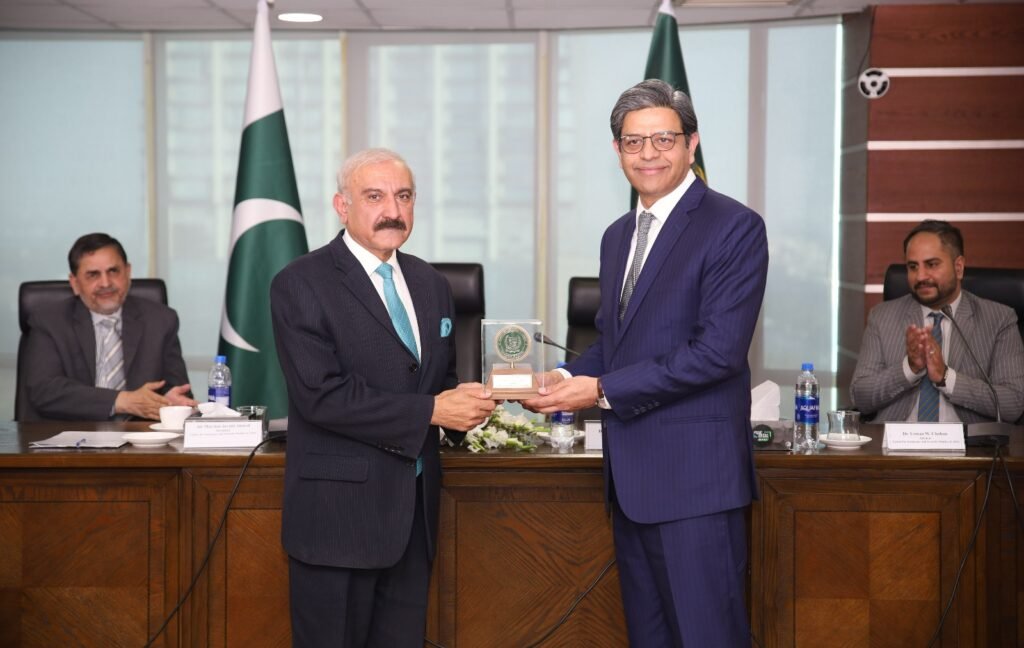
ISLAMABAD: As part of its ongoing Lecture Series on Competition Law, the Competition Commission of Pakistan (CCP) hosted a special session featuring Air Marshal Javaid Ahmed, HI (M) (Retd), President Centre for Aerospace and Security Studies (CASS), and Dr. Usman W. Chohan, Advisor CASS, on the theme “Role of Aviation Industry in Economic Affairs and National Development.” CASS is Pakistan’s premier centre for strategic research on aerospace, emerging technologies, security, and national policy.
Welcoming the speakers, CCP Chairman Dr. Kabir Sidhu said that regulatory frameworks across major sectors in Pakistan remain outdated and require urgent modernization to meet the demands of rapidly evolving markets. He highlighted that CCP’s Centre of Excellence is conducting in-depth sectoral studies to identify regulatory gaps, market inefficiencies, and provide evidence-based recommendations for reforms. The Centre has completed studies in over fifteen key sectors, including LNG, Power, sugar, Insurance, Fertilizer, Road Infrastructure, and Gold.
Read More: https://theboardroompk.com/pm-promises-live-tv-coverage-for-pia-privatization-bids-on-december-23/
Air Marshal Javaid Ahmed (Retd) delivered a comprehensive lecture on the dynamics of the global and domestic aviation industry. He cautioned that Pakistan’s aviation sector needs urgent modernization to unlock its potential in tourism, cargo movement, technology development, skilled employment, and national security, as highlighted under the Significance of Aviation Industry framework in his presentation. He outlined Pakistan’s aviation challenges, including high operational costs, weak governance structures, security constraints, sectoral inefficiencies, limited private sector participation, and shortage of skilled workforce.
Highlighting opportunities, he expressed that Pakistan possesses strong aeronautical capabilities and will “soon be able to manufacture a passenger aircraft,” given its advanced fighter aircraft ecosystem. He also briefed the audience about the National Aerospace Science and Technology Park (NASTP), a multi-site initiative equipped with high-end laboratories in AI, avionics, cyber, robotics, composites, and satellite technologies. NASTP aims to build Pakistan’s first integrated aerospace ecosystem, expand dual-use technologies, and position the country as a regional innovation hub.
Dr. Usman W. Chohan presented key economic indicators, noting that aviation contributes $5.6 billion to Pakistan’s GDP (1.7%), supports 684,000 jobs, and generated 22 million passengers in 2023, a figure expected to rise under the National Aviation Policy 2023. He underlined that Pakistan’s flight market revenue is projected to grow from $6.04B in 2025 to $8.17B by 2030, with users rising to 48.5 million. He emphasized aviation’s critical role in trade, connectivity, tourism, and broader economic competitiveness.
The session concluded with an engaging question-and-answer discussion, attended by senior officials, researchers of the CCP, and industry stakeholders.