
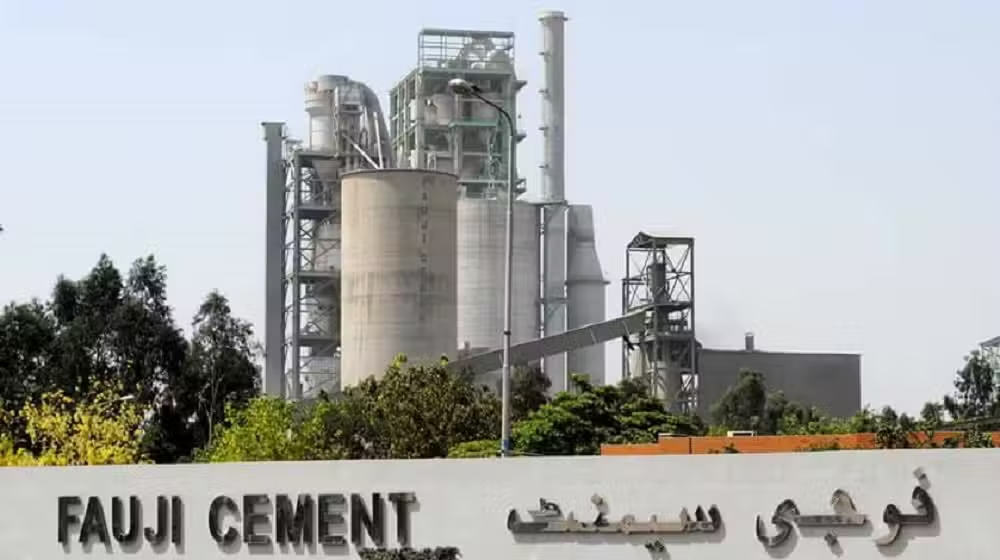
Fauji Cement Company Limited (FCCL) increased domestic cement sales in FY26, supported by improved construction demand, infrastructure activity and public sector development spending. However, the year ended with a significant decline in exports and rising production costs, as the closure of the Afghan border and higher coal prices put pressure on the company’s operating environment.
According to Taurus Securities, total cement dispatches increased by approximately 6% to 5.7 million tons during FY26. Growth was driven by the domestic market, which helped offset the sharp decline in exports.
Afghan Border Closure Hits Cement Exports
Fauji Cement’s exports declined by approximately 48% year-on-year following the closure of the Afghan border in October 2025, according to Taurus Securities.
The disruption affected cross-border sales and reduced the company’s export volumes, making domestic demand increasingly important to overall dispatch growth.
Local dispatches reached approximately 5.4 million tons in FY26, representing an increase of around 13%. Better construction demand, steadier infrastructure activity and spending under the Public Sector Development Programme (PSDP) supported domestic sales.
Despite the increase in dispatches, Fauji Cement’s market share remained unchanged at 16%. The figures indicate that the company expanded sales in its home market but did not increase its overall share of the domestic cement market.
Rising Coal Prices Increase Production Costs
Higher fuel and energy expenses emerged as a key challenge for Fauji Cement during FY26. Management attributed the increase in production costs primarily to rising coal prices in the fourth quarter.
Coal averaged approximately Rs40,000 per ton during the financial year but has since moved closer to Rs60,000 per ton, including freight costs of around Rs15,000 to Rs16,000.
The higher coal price creates additional pressure on cement manufacturing costs, particularly as fuel remains an important input in production.
Fauji Cement’s coal procurement mix comprised approximately 75% locally sourced coal and 25% imported coal from South Africa and Mozambique. Management indicated that maintaining this sourcing mix depends partly on geopolitical conditions stabilising.
Uncertainty in international markets and supply routes could therefore affect fuel costs and the availability of imported coal.
Grid Electricity Adds to the Cost Burden
Energy costs remain another concern for the company. Approximately 51% of Fauji Cement’s power comes from renewable sources, while the remaining 49% is purchased from the national grid at an estimated Rs30 to Rs32 per unit.
Although renewable energy accounts for about half of the company’s power mix, grid electricity remains a significant expense for the manufacturing operation.
Packaging costs appear comparatively less exposed to recent pressures. Polypropylene bags cost approximately Rs30 each, while the company’s own production now covers most of its packaging requirements.
As a result, the main cost pressures highlighted by management relate to fuel and electricity rather than packaging.
Cement Prices Offer Only Partial Relief
Fauji Cement’s retention has reached approximately Rs900 per bag, compared with around Rs870 to Rs875 during FY26.
The increase provides some support against rising production expenses. However, the improvement in retention does not fully offset the sharp increase in coal prices.
This leaves the company exposed to continued cost volatility, particularly if fuel prices remain elevated or geopolitical developments disrupt supply arrangements.
The balance between selling prices and production costs will remain important in determining whether stronger domestic dispatches translate into improved operating performance.
Royalty Liabilities Remain a Financial Consideration
Fauji Cement has accrued royalty liabilities estimated at Rs7 billion to Rs8 billion. These obligations remain an important financial consideration alongside the company’s rising operating costs.
The scale of the accrued liabilities makes their management relevant to the company’s broader financial position, particularly as it navigates higher coal prices and other cost pressures.
The timing and treatment of these obligations could influence the company’s financial flexibility, although the available information does not specify a settlement schedule.
Foreign-Currency Loan Adds Exchange-Rate Risk
The company also borrowed in foreign currency to retire part of its more expensive local debt and finance the acquisition of a stake in Attock Cement. Its holding in Attock Cement now stands at approximately 46%.
Management wants to repay the foreign-currency borrowing quickly because of the exchange-rate risk associated with dollar-denominated liabilities.
Around Rs6 billion in principal and another Rs4 billion to Rs5 billion in mark-up remain to be paid, according to the information provided.
While refinancing costlier local debt and acquiring the Attock Cement stake were key purposes of the borrowing, the remaining obligation exposes Fauji Cement to currency movements. A weaker rupee could increase the local-currency burden of servicing the dollar loan.
The repayment of this borrowing will therefore remain an important consideration as the company balances expansion, financing costs and operational requirements.
FY27 Outlook Depends on Domestic Demand and Geopolitics
Fauji Cement expects domestic cement demand to grow by approximately 8% to 10% in FY27, conditional on geopolitical conditions stabilising.
Housing schemes could provide additional support for domestic sales, alongside construction activity and infrastructure spending.
However, the outlook remains subject to several uncertainties. The Afghan border situation could continue to affect export volumes, while coal prices and grid electricity costs may place further pressure on production expenses.
The foreign-currency loan and accumulated royalty liabilities also remain important financial considerations.
Key Risks for Fauji Cement in FY27
Fauji Cement enters FY27 with stronger domestic dispatches but faces a challenging combination of cost and financial pressures. The principal risks include:
- Export disruption: The Afghan border closure has sharply reduced exports and weakened the company’s ability to rely on external markets.
- Higher fuel costs: Coal prices have risen substantially from their FY26 average, putting pressure on production expenses.
- Energy expenses: Grid electricity costs remain significant despite the contribution of renewable power.
- Financial obligations: Accrued royalty liabilities and the outstanding foreign-currency loan require continued attention.
- Demand uncertainty: The expected 8% to 10% growth in domestic demand depends partly on geopolitical stability.
Fauji Cement’s performance in FY27 will depend on whether stronger domestic demand and improved selling-price retention can offset higher fuel costs and financial risks. For now, the Afghan border situation, coal prices and dollar-denominated borrowing remain the key uncertainties shaping its outlook.