
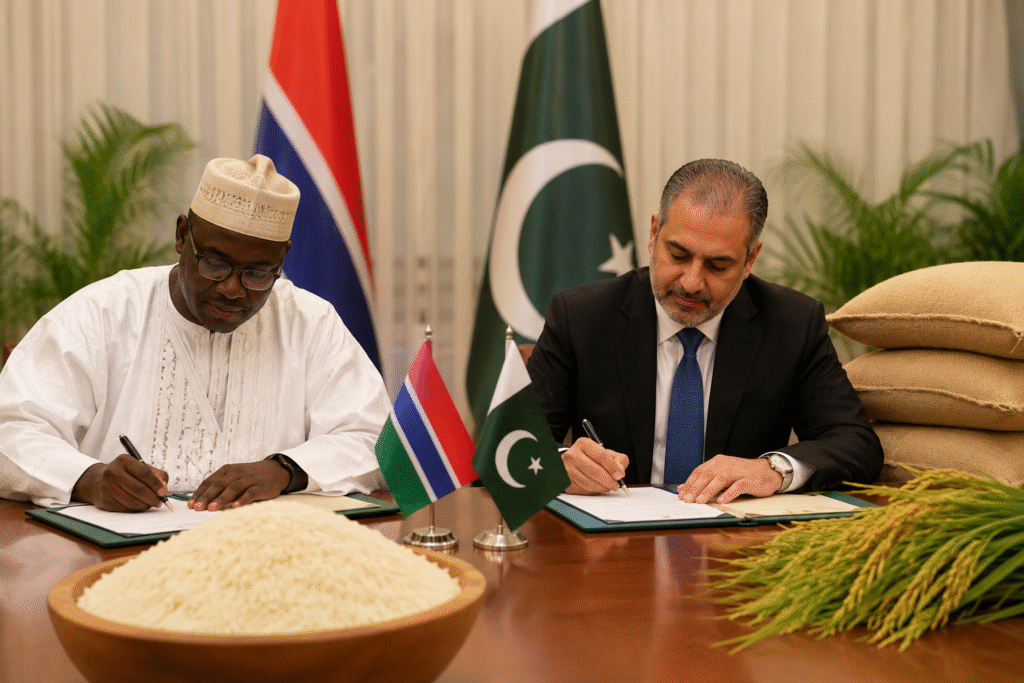
Pakistan is moving closer to expanding its agricultural exports to West Africa as the Ministry of Commerce has sought federal cabinet approval to sign a Memorandum of Understanding (MoU) with The Gambia for stronger bilateral cooperation in agricultural trade, particularly rice exports.
The proposed agreement comes after the Gambian government approached the Trading Corporation of Pakistan (TCP) to establish formal government-to-government (G2G) cooperation for the import of agricultural commodities from Pakistan.
Officials said the move could open a major new export market for Pakistani rice and strengthen trade ties between the two countries.
Gambia Shows Strong Interest in Pakistani Rice
According to officials familiar with the development, recent engagements facilitated by the Trade Development Authority of Pakistan played an important role in advancing discussions between the two sides.
During these meetings, Gambian officials reportedly expressed strong interest in importing Pakistani rice due to its quality and competitive pricing in international markets.
Sources said The Gambia has indicated a demand of around 145,000 metric tons of rice. The expected imports could provide a significant boost to Pakistan’s rice export sector, which remains one of the country’s largest foreign exchange earners.
Pakistan is among the world’s leading rice exporters, especially known for its basmati and non-basmati varieties. Exporters believe that expanding into African markets could help diversify export destinations and reduce dependence on traditional buyers.
Cabinet Approval Sought for MoU
The Ministry of Commerce has now forwarded a summary to the federal cabinet seeking approval to formally sign the MoU with the Gambian side.
Officials said the agreement aims to establish a structured framework for agricultural cooperation and streamline trade between the two governments. The proposed arrangement is also expected to improve coordination between relevant institutions and facilitate long-term commodity supply agreements.
The Trading Corporation of Pakistan is expected to play a central role in implementing the agreement once approved.
Industry stakeholders believe the government-to-government model could strengthen confidence among buyers and ensure stable exports.
Pakistan Expanding Presence in African Markets
Pakistan has recently intensified efforts to expand trade relations with African countries under its “Look Africa” policy. Authorities are encouraging exporters to explore emerging markets across the continent for food products, textiles, pharmaceuticals, and other goods.
Trade experts say Africa’s growing population and rising food demand present significant opportunities for Pakistani exporters.
Rice exporters have also welcomed the proposed agreement with The Gambia, saying it could pave the way for similar arrangements with other African nations.
They added that Pakistan’s rice sector has the capacity to meet large international orders while maintaining competitive prices.
Rice Exports Remain Vital for Economy
Rice exports continue to play a crucial role in Pakistan’s economy. The sector contributes billions of dollars annually in export earnings and supports thousands of farmers, millers, and exporters across the country.
Officials hope that stronger cooperation with African markets will further increase export volumes and improve foreign exchange inflows at a time when Pakistan is seeking to stabilize its external sector.
If approved by the federal cabinet, the MoU is expected to mark another step in Pakistan’s broader strategy to strengthen economic diplomacy and expand agricultural exports globally.