
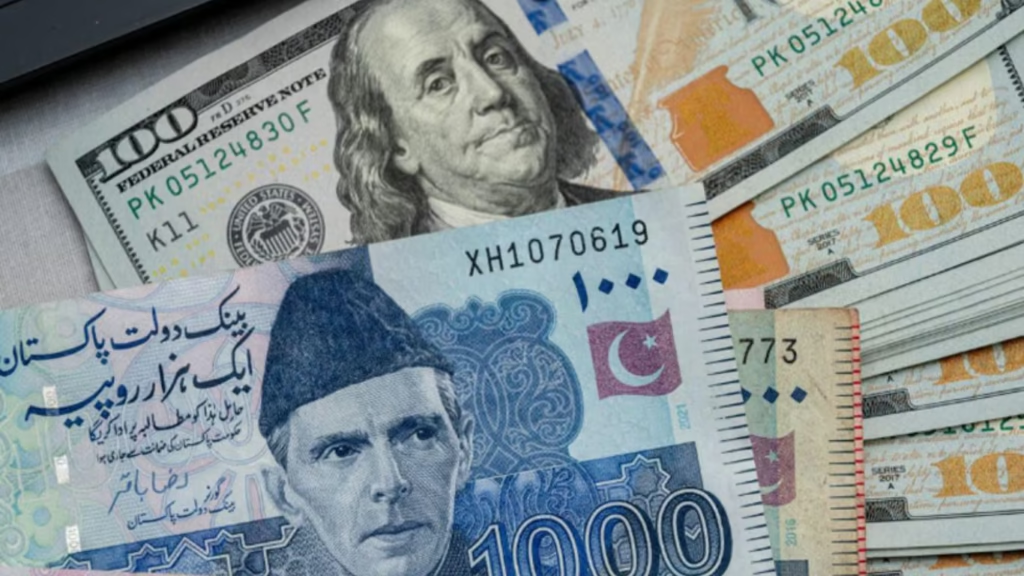
The Pakistani rupee against dollar showed slight stability on Friday as the local currency posted a marginal gain in the inter bank market. The rupee closed at 278.85 against the US dollar, improving by Re0.01 compared to the previous day’s close of 278.86.
Although the gain appears small, it reflects a steady trend in the currency market amid global uncertainty and upcoming policy decisions by the State Bank of Pakistan.
Rupee Stability Comes Before Key Policy Decision
Market participants are closely watching the upcoming Monetary Policy Committee meeting of the State Bank of Pakistan scheduled for April 27, 2026. This will be the third policy review of the year.
The central bank is expected to assess inflation trends, external account conditions, and economic stability before deciding on the key policy rate. Analysts believe that the decision could influence currency movement in the coming weeks. A stable or tighter policy stance may help support the rupee, while any unexpected shift could create volatility.
Dollar Gains Strength in Global Market
While the Pakistani rupee showed slight improvement, the US dollar remained firm in the global market. The US dollar index, which tracks the greenback against major currencies, stood at 98.82.
The index is on track for a weekly gain of around 0.58 percent, marking its first weekly rise in three weeks. This indicates renewed strength in the dollar against currencies like the euro and the British pound. The euro remained steady at 1.1683 dollars, while the British pound edged slightly lower to 1.3464 dollars.
Oil Prices Drive Currency Trends
Global oil prices have played a key role in shaping currency movements. Analysts note that the dollar often moves in line with oil price trends.
Sho Suzuki stated that the dollar continues to hold firm as crude oil prices rise. He explained that the close relationship between oil and the dollar remains intact, especially during periods of geopolitical tension.
Higher oil prices usually strengthen the dollar, which can put pressure on emerging market currencies like the Pakistani rupee.
Middle East Tensions Push Oil Higher
Oil prices surged on Friday due to rising tensions in the Middle East. Concerns grew after Iran released footage of commandos boarding a cargo ship in the Strait of Hormuz. Reports also suggested that Tehran’s air defenses engaged hostile targets, raising fears of a broader military escalation.
As a result, Brent crude futures climbed to over 106 dollars per barrel. Meanwhile, West Texas Intermediate crude reached around 96 dollars per barrel. Both benchmarks recorded strong weekly gains. Brent rose more than 17 percent, while WTI increased by over 15 percent. This marks one of the biggest weekly jumps since the start of the conflict.
Impact on Pakistan’s Economy
Rising oil prices pose challenges for Pakistan’s economy. The country relies heavily on imported fuel, which increases pressure on foreign exchange reserves.
Higher oil import costs can widen the trade deficit and weaken the rupee over time. This makes currency stability more difficult to maintain. However, the recent marginal gain in the Pakistani rupee against dollar suggests that short term pressures remain under control.
Market Awaits Clear Direction
Investors and traders are now looking toward the upcoming policy meeting for guidance. The State Bank of Pakistan will play a crucial role in shaping market sentiment.
A clear and consistent policy approach could help maintain stability in the currency market. On the other hand, global factors such as oil prices and geopolitical risks will continue to influence trends.
A Delicate Balance Ahead
The Pakistani rupee against dollar remains in a delicate position. While domestic indicators show some stability, external pressures continue to build.
Global oil prices, dollar strength, and geopolitical tensions all contribute to uncertainty. At the same time, policy decisions at home will determine how well the economy navigates these challenges.
For now, the slight gain in the rupee offers a signal of resilience. However, the coming weeks will be critical in defining its direction.