
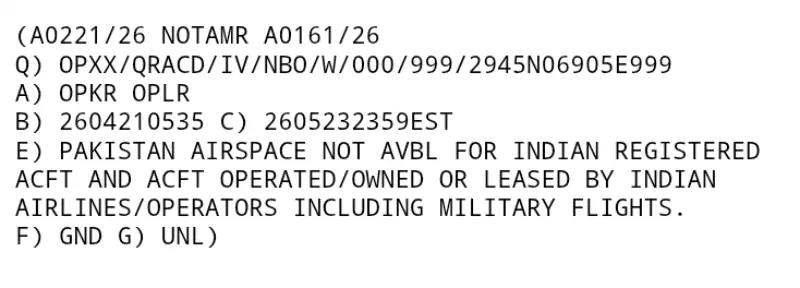
The restrictions on Indian airlines continue as Pakistan officially extended its airspace ban for another month, pushing the deadline to May 24, 2026. The move marks nearly one year since both countries imposed reciprocal aviation restrictions following escalating tensions in 2025.
PAA Issues Fresh NOTAM
The Pakistan Airport Authority issued a new Notice to Airmen (NOTAM) confirming that Pakistani airspace will remain closed to all Indian-registered aircraft and operators. The directive applies to commercial flights as well as military aircraft.
According to the official statement, the ban will remain in force until 4:59am on May 24, 2026. The previous extension was set to expire on April 24, but authorities decided to prolong the restrictions amid ongoing tensions.
The notification clearly stated that no aircraft linked to Indian airlines or operators would be allowed to use Pakistani airspace during this period.
Ban Covers Major Airspace Regions
The restriction applies to both key flight zones managed by Pakistan. These include the Karachi Flight Information Region and the Lahore Flight Information Region.
These regions play a critical role in regional and international air traffic. Their closure forces Indian airlines to reroute flights, particularly those traveling to Europe, the Middle East, and North America.
As a result, airlines face longer flight durations and higher operational costs due to increased fuel consumption.
Background: Crisis Since April 2025
The aviation standoff between Pakistan and India began in late April 2025. The escalation followed a deadly attack in Pahalgam.
India accused Pakistan of supporting the attack. However, Islamabad strongly denied the allegations and called for an independent investigation. Despite this, tensions continued to rise, leading both countries to shut their airspace to each other’s carriers.
Pakistan responded to India’s actions by immediately closing its airspace to all aircraft operated or owned by Indian airlines.
Military Escalation Deepened Impact
The situation intensified further in May 2025, when both countries engaged in a major aerial confrontation. Pakistani officials claimed that their forces shot down several Indian fighter jets during the conflict.
This military escalation reinforced the continuation of aviation restrictions and hardened positions on both sides. Since then, no significant diplomatic breakthrough has been achieved to restore normal air traffic.
Economic and Operational Impact
The continued ban has significantly affected Indian airlines. Carriers have been forced to adopt longer routes, increasing fuel costs and operational expenses. Flights to Western destinations now require detours that add hours to travel time.
Passengers also face indirect consequences, including higher ticket prices and extended journey durations. Meanwhile, the aviation sector in the region continues to experience disruption due to the prolonged standoff.
Pakistan, on the other hand, also faces reduced overflight revenues. However, analysts view the decision as primarily driven by security concerns rather than economic considerations.
No Immediate Resolution in Sight
Despite the extension, there are no clear signs of de-escalation between the two nuclear-armed neighbors. Diplomatic engagement remains limited, and both sides continue to maintain firm positions.
Experts believe that the continuation of restrictions on Indian airlines reflects deeper geopolitical tensions that extend beyond aviation issues. Without meaningful dialogue, the airspace ban may continue in the coming months.