
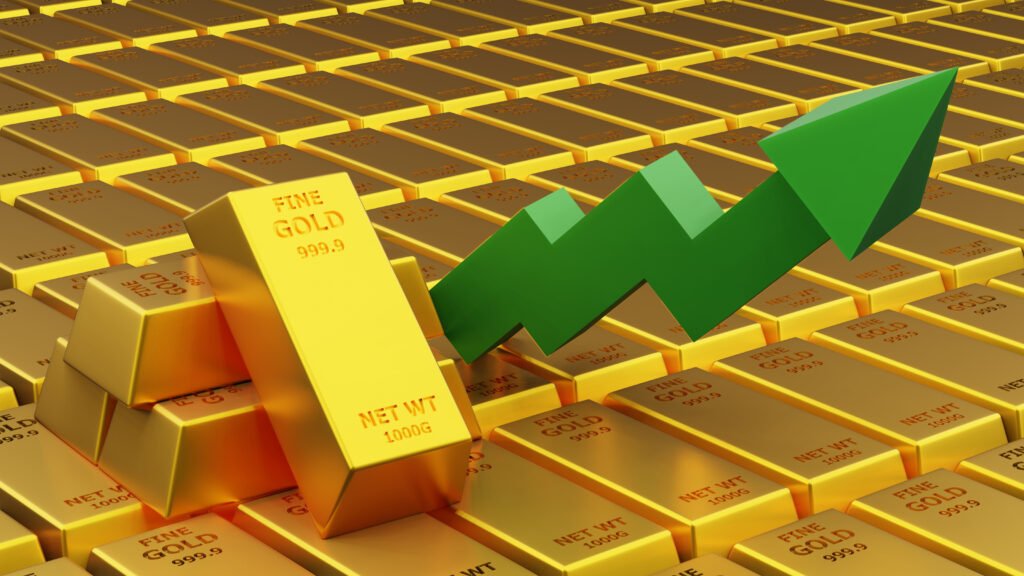
The Gold Price Surge 2026 has captured global attention as prices climbed sharply on Monday, fueled by escalating geopolitical tensions in the Middle East. Investors rushed toward gold, reinforcing its long-standing reputation as the ultimate safe-haven asset during times of crisis.
The latest spike follows a dramatic escalation involving military strikes reportedly carried out by the United States and Israel on Iran, with reports indicating the death of Ayatollah Ali Khamenei. These developments have significantly heightened geopolitical risks, sending shockwaves through global financial markets.
As of 9:18 AM PST, spot gold surged 1.57% to $5,358.69 per ounce, according to Reports. This sharp increase reflects a broader trend of investors seeking stability amid rising uncertainty.
Why the Gold Price Surge 2026 Is Gaining Momentum
Gold’s rally is not an isolated event it is the continuation of a powerful upward trend. In 2025 alone, gold prices surged an extraordinary 64%, driven by multiple reinforcing factors.
Central banks around the world have been aggressively increasing their gold reserves, signaling strong institutional confidence. At the same time, exchange-traded funds (ETFs) have seen sustained inflows, indicating robust investor demand.
Expectations around monetary policy have also played a key role. Analysts anticipate that the Federal Reserve may shift toward easing interest rates, a move that typically supports gold prices by reducing the opportunity cost of holding non-yielding assets.
Financial media outlet CNBC reports that gold has already surged more than 2% recently, reaching its highest level in over four weeks further evidence of bullish momentum.
Gold Price Surge 2026 Forecast: Can Prices Hit $6,000?
Major global financial institutions remain highly optimistic about gold’s future trajectory. Analysts at J.P. Morgan and Bank of America have reiterated projections that gold could approach, or even exceed, the $6,000 mark.
J.P. Morgan has gone a step further, forecasting that sustained demand from central banks and institutional investors could push prices to $6,300 per ounce by the end of 2026.
This bullish outlook is grounded in a combination of structural demand and macroeconomic uncertainty. Rising geopolitical risks, inflation concerns, and shifting monetary policies all point toward continued strength in gold markets.
Economic Signals Adding Fuel to the Gold Price Surge 2026
Recent economic data from the United States has added another layer of complexity to the global outlook. Producer prices rose more than expected in January, signaling that inflationary pressures may persist longer than anticipated.
This has placed renewed focus on upcoming labor market data, including employment reports and nonfarm payroll figures. These indicators will be closely watched for clues about the direction of monetary policy and overall economic health.
If inflation remains elevated while economic growth slows, gold could benefit further as investors hedge against stagflation risks.
Performance of Other Precious Metals
While gold shines, other precious metals have shown mixed performance, reflecting shifting investor sentiment.
Silver experienced a slight pullback after a strong February, declining by 1.2% to $92.72 per ounce. Platinum also dipped nearly 1% to $2,343.50, while palladium managed a modest gain of 0.5%, reaching $1,795.11 per ounce.
These movements highlight gold’s dominant position as the preferred safe-haven asset during periods of geopolitical and economic uncertainty.
What the Gold Price Surge 2026 Means for Investors
The Gold Price Surge 2026 underscores a critical shift in investor behavior. In times of heightened uncertainty, capital flows toward assets perceived as stable and reliable.
For investors, this presents both opportunity and caution. While gold’s upward trajectory offers potential gains, its rapid rise also raises questions about sustainability and market corrections.
The interplay between geopolitical developments, central bank policies, and economic data will ultimately determine whether gold continues its ascent or stabilizes in the months ahead.