
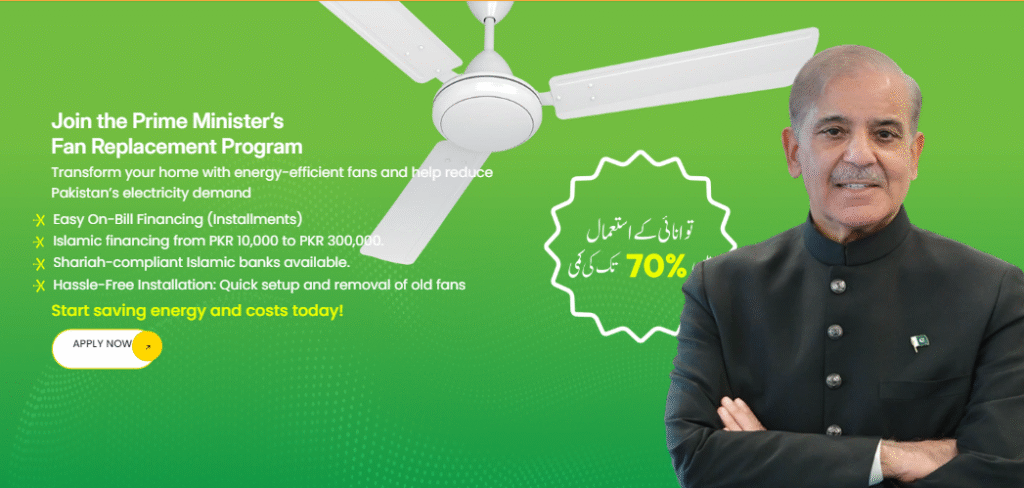
The Prime Minister’s Fan Replacement Program has officially taken off and it’s not just another policy announcement. It’s a bold, climate-focused initiative that could quietly transform millions of households while easing Pakistan’s power crisis.
Backed by strong financial support from the Ministry of Finance, the program is designed to replace conventional electricity-hungry fans with modern, energy-efficient models. The real game changer? A Rs2 billion risk guarantee aimed at unlocking consumer financing and accelerating adoption nationwide.
Why the Prime Minister’s Fan Replacement Program Matters Now
Pakistan faces mounting pressure to reduce energy consumption, manage fiscal deficits, and meet climate commitments. The Prime Minister’s Fan Replacement Program addresses all three challenges at once.
Traditional ceiling fans are among the most widely used electrical appliances in the country. Many older models consume significantly more electricity than newer inverter-based or brushless DC (BLDC) fans. Replacing them at scale could reduce national electricity demand, lower consumer bills, and cut carbon emissions all without disrupting daily life.
Federal Minister for Finance and Revenue, Senator Muhammad Aurangzeb, reaffirmed the government’s commitment to the initiative, declaring it a high-priority reform aligned with fiscal sustainability and climate resilience goals.
How the Rs2 Billion Risk Guarantee Works
At the heart of the Prime Minister’s Fan Replacement Program is a smart financial innovation.
The Ministry of Finance has allocated PKR 2 billion as a 10% first-loss risk guarantee. In practical terms, this means:
• The government will absorb up to 10% of initial credit losses.
• This reduces the lending risk for banks.
• Banks are therefore more willing to offer affordable financing to consumers.
• Households can replace old fans without heavy upfront costs.
This approach transforms what could have been a subsidy-heavy program into a sustainable financing model leveraging private sector capital rather than relying solely on public funds.
Early Success: Pilot Phase Proves the Model
Even before its official launch, the Prime Minister’s Fan Replacement Program quietly tested its framework.
In collaboration with the State Bank of Pakistan and 11 commercial banks, a pilot phase delivered promising results:
• 186 energy-efficient fans installed
• Rs1.35 million disbursed
• 67 borrowers financed
While modest in scale, the pilot successfully validated the digital enablement systems, financing channels, and disbursement processes. The operational backbone is now fully functional removing one of the biggest barriers to nationwide rollout.
Leadership Driving the Initiative
The Finance Minister credited Federal Minister for Power Awais Leghari for spearheading the initiative within the energy sector. The coordination between the Finance Ministry, the Power Division, the State Bank, and commercial banks signals a rare alignment across institutions.
This collaboration is critical. Without synchronized execution, even well-funded reforms struggle. With it, the Prime Minister’s Fan Replacement Program could scale rapidly potentially reaching millions of households far sooner than the originally envisioned 10-year timeline.
The Bigger Economic and Climate Impact
The significance of the Prime Minister’s Fan Replacement Program extends beyond household savings.
Energy-efficient fans can consume up to 50–60% less electricity compared to conventional models. At scale, this could:
• Reduce national peak electricity demand
• Lower circular debt pressure in the power sector
• Decrease fuel imports
• Support Pakistan’s climate action commitments
• Improve fiscal sustainability
For consumers, the benefits are immediate smaller electricity bills. For the government, the payoff is structural reform. For the environment, the impact is long-term emissions reduction.
A Small Appliance, A Big Shift
On the surface, replacing ceiling fans may not sound revolutionary. But in a country where fans run for long hours across millions of homes, the cumulative effect is enormous.
The Prime Minister’s Fan Replacement Program is a reminder that sometimes the most powerful economic reforms begin not in boardrooms but in living rooms.
If successfully scaled, this initiative could become a model for appliance replacement programs across South Asia, proving that climate action and fiscal discipline can move forward together.