
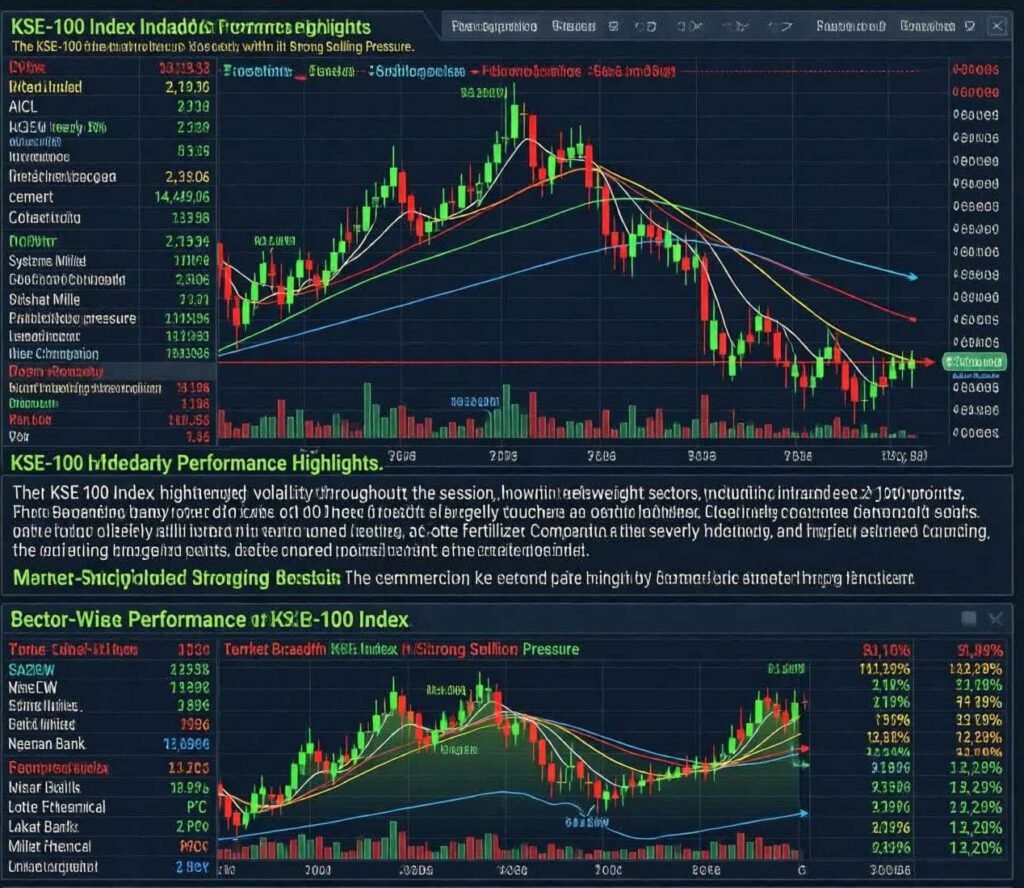
KSE-100 Index witnessed a dramatic downturn on Thursday, closing at 180,512.64, down 2,537.16 points (-1.39%), as uncertainty surrounding Barrick Gold’s $6 billion Reko Diq copper-gold project rattled investor sentiment.
The decline was not just another routine market correction it reflected deeper concerns about Pakistan’s investment climate and the future of large-scale foreign projects.
Why the KSE-100 Index Fell: The Reko Diq Factor
The primary trigger behind the KSE-100 Index slump was Barrick Gold Corporation’s statement indicating it is reviewing the development timeline and capital budget of the Reko Diq project due to rising security risks in Balochistan.
For investors, this signaled potential delays in one of Pakistan’s largest foreign direct investment (FDI) ventures. The uncertainty sparked fears about:
• Foreign investor confidence
• Political and security stability
• Long-term economic growth prospects
The market reacted swiftly and sharply.
KSE-100 Index Trading Range Reflects Volatility
The KSE-100 Index traded within a wide range of 4,031 points, highlighting the day’s volatility.
• Intraday High: 182,757
• Intraday Low: 178,725
This massive swing underscores how sensitive the Pakistan Stock Exchange (PSX) currently is to geopolitical and investment-related developments.
Total traded volume for the KSE-100 stood at 448.22 million shares, reflecting heavy selling pressure.
Market Breadth: Overwhelmingly Negative
Out of 100 companies in the index:
• 18 stocks closed positive
• 80 stocks declined
• 2 remained unchanged
This broad-based decline indicates that the sell-off was not limited to a few sectors it was widespread.
Major laggards included:
• HUM Network (down 6.02%)
• IBFL (down 6.00%)
• Engro Fertilizers (down 5.14%)
• Thal Limited (down 5.11%)
• Standard Chartered Bank (down 4.67%)
On the flip side, a few stocks managed gains, including PIOC (+2.21%) and RMPL (+2.07%), but these were insufficient to offset the broader decline.
Sector-Wise Impact on the KSE-100 Index
The KSE-100 Index was dragged down primarily by heavyweight sectors:
• Commercial Banks contributed a massive 730-point decline
• Oil & Gas Exploration shaved off 437 points
• Technology & Communication lost over 220 points
• Cement sector reduced 202 points
• Power Generation dropped 192 points
These sectors collectively amplified the downward momentum.
Meanwhile, smaller positive contributions came from Transport, Paper & Packaging, and Tobacco but their impact was marginal.
Broader Market Performance
The bearish trend extended beyond the benchmark.
The All-Share Index fell by 1,441 points (-1.31%), closing at 108,400.
Interestingly, overall market activity increased:
• Total market volume rose to 874 million shares
• Traded value surged to Rs41.77 billion
• 441,474 trades were recorded across 484 companies
Despite higher participation, the majority of stocks 342 companies closed in negative territory.
Most Active Stocks by Volume
K-Electric led trading volumes with nearly 177 million shares changing hands, followed by CNERGY and AMTEXNC. While some stocks like EPCL posted gains (+6.04%), the majority of high-volume shares closed lower, reinforcing bearish sentiment.
Bigger Picture: Still a Strong Fiscal Year
Despite today’s drop, the KSE-100 Index has delivered remarkable gains over the fiscal year:
• Up 54,885 points (43.69%) in FY so far
• Up 6,458 points (3.71%) in the current calendar year
•
This indicates that while short-term volatility is intense, the broader market trend remains resilient.
What Comes Next for the KSE-100 Index?
The future trajectory of the KSE-100 Index may largely depend on:
• Clarity on the Reko Diq project timeline
• Improvement in security perceptions
• Stability in macroeconomic indicators
• Continued foreign investor confidence
If reassurance emerges from policymakers or Barrick Gold, the market could stage a recovery. However, prolonged uncertainty may keep volatility elevated.
Final Thoughts
The latest plunge in the KSE-100 Index serves as a reminder that investor confidence is deeply tied to large-scale investment projects and geopolitical stability. While Pakistan’s stock market has shown impressive growth this fiscal year, sustaining momentum will require consistent policy clarity and security assurance.
For investors, the coming sessions could prove decisive. Will this dip create a buying opportunity or signal deeper concerns ahead?
Stay tuned as the KSE-100 Index navigates this critical juncture.