
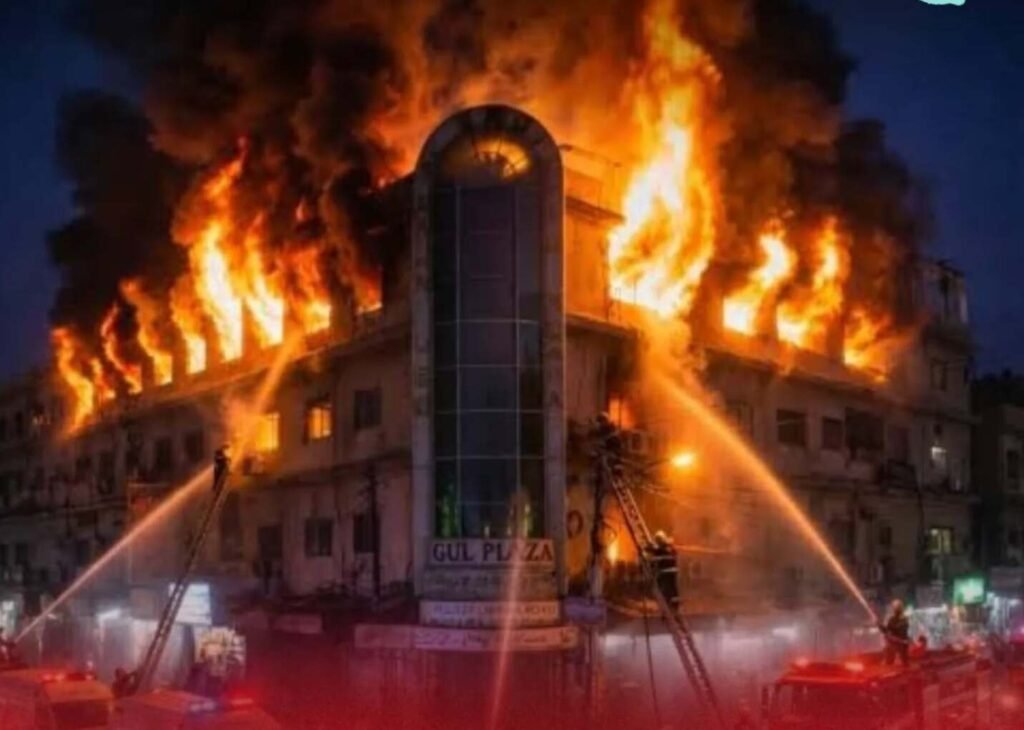
The Gul Plaza fire judicial inquiry has officially been announced, marking a critical moment for accountability, governance reform, and public safety in Sindh’s largest metropolis. As Karachi continues to expand vertically and commercially, the tragedy at Gul Plaza has exposed alarming weaknesses in fire safety compliance, emergency preparedness, and inter-departmental coordination issues now under the judicial microscope.
Senior Sindh Minister Sharjeel Inam Memon, speaking at a press conference in Karachi, confirmed that the provincial government will formally request the Sindh High Court Chief Justice to appoint a serving judge to conduct a comprehensive judicial inquiry into the deadly blaze. The decision, he said, aims to restore public trust and ensure transparent accountability across departments.
Why the Gul Plaza Fire Judicial Inquiry Matter
The Gul Plaza fire judicial inquiry was initiated after a high-level cabinet sub-committee chaired by Chief Minister Murad Ali Shah spent nearly five hours reviewing reports from the Karachi commissioner and additional inspector general of police.
What emerged was deeply troubling.
Fire safety audits had been conducted at Gul Plaza and several other buildings as early as 2023, yet no effective corrective, precautionary, or legal actions were enforced. Despite repeated warnings, regulatory failures allowed risks to compound ultimately culminating in disaster.
This inquiry now represents more than an investigation; it is a litmus test for institutional reform in Sindh’s urban governance framework.
Suspensions Highlight Systemic Failure
One of the most consequential outcomes of the Gul Plaza fire judicial inquiry announcement was the immediate suspension of key officials.
Civil Defence authorities responsible for enforcing fire safety regulations failed to act despite issuing multiple notices to Gul Plaza’s management. These notices clearly stated that the building lacked adequate emergency safety arrangements. The inability to follow through led to the suspension of both the Civil Defence director and the additional controller of the South district.
According to the Sindh government, departmental proceedings have been initiated, and officials at higher levels may also face suspension if evidence reveals negligence or ignored directives.
Water Supply Delays and Emergency Response Breakdown
The inquiry process also uncovered a critical failure in emergency response logistics.
During the firefighting operation, there was a delay in supplying water to fire tenders, severely affecting the Karachi Metropolitan Corporation (KMC) Fire Brigade and Rescue 1122 operations. As a result, the chief engineer (bulk) and the hydrants in-charge of the Karachi Water and Sewerage Corporation (KWSC) were suspended.
This decision underscores how fragmented service delivery can transform emergencies into catastrophes an issue the Gul Plaza fire judicial inquiry is expected to address in detail.
Firefighters’ Courage Amid Limited Resources
Despite systemic shortcomings, frontline responders displayed extraordinary bravery.
The inquiry acknowledged that KMC Fire Brigade and Rescue 1122 lacked sufficient equipment, training, and technical capability to manage a blaze of this scale. Yet firefighters continued their efforts under extreme conditions. Tragically, firefighter Furqan Shaukat lost his life in the line of duty a stark reminder of the human cost of institutional neglect.
Further action has been taken against the KMC municipal services senior director, who was suspended for failing to ensure adequate preparedness and training of firefighting personnel.
The Day of the Tragedy: What Happened at Gul Plaza
On January 17, when the fire erupted, an estimated 2,000 to 2,500 people were present inside Gul Plaza, including workers and visitors. Swift evacuations saved many lives, but the chaos still left around 80 individuals affected by the blaze.
Government employees and rescue workers played a crucial role in evacuations, but officials admit that better planning and enforcement could have prevented the scale of damage.
What Comes Next After the Gul Plaza Fire Judicial Inquiry
The Gul Plaza fire judicial inquiry is expected to reshape conversations around commercial building compliance, emergency readiness, and accountability mechanisms in Karachi and beyond.
For businesses, developers, insurers, and investors, the inquiry sends a clear message: regulatory oversight is tightening, and negligence will carry consequences. For citizens, it raises hope that long-standing safety concerns will finally translate into enforceable action.