
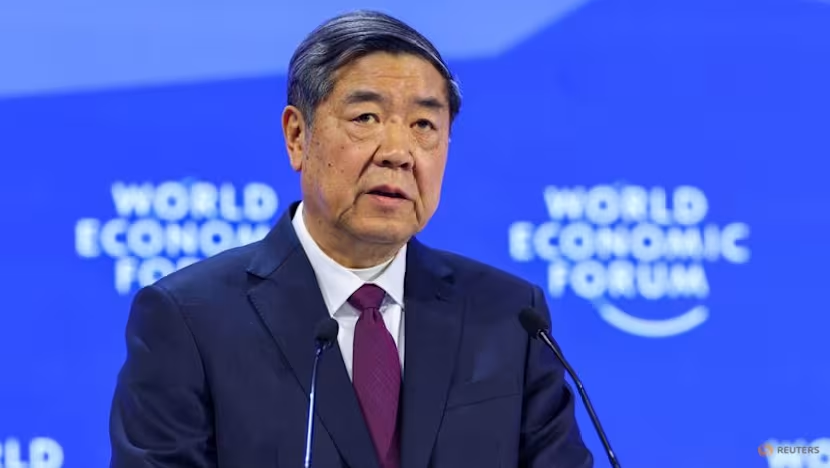
China adopted a notably low-key presence at the World Economic Forum’s Annual Meeting in Davos, Switzerland, held from January 19-23, 2026, as it sought to attract Western investment amid economic headwinds and geopolitical tensions.
Unlike previous years with high-profile delegations and prominent pavilions, China’s footprint was subdued, reflecting a strategic shift focused on quiet diplomacy and targeted outreach.
Subdued Visibility and Contrast with Others
China’s delegation maintained a minimal public profile, with fewer events, smaller promotional setups, and limited visibility on Davos’ main street compared to past gatherings. This approach stood in stark contrast to the United States, which featured a more assertive and visible participation, including prominent business leaders and policy messaging.
Chinese officials avoided large-scale media spectacles, opting instead for behind-the-scenes meetings and bilateral discussions to court foreign capital.
Key Participation and Messaging
Vice Premier He Lifeng delivered a special address at the forum on January 20, 2026, emphasizing China’s commitment to openness, multilateralism, and global cooperation. He stated that China never deliberately pursued trade surpluses and is willing to serve as “the world’s market.”
He Lifeng highlighted efforts to boost investment in physical assets and human capital, expand consumption in priority sectors, and promote high-standard opening-up. He called for joint responses to challenges like fragmentation and protectionism, positioning China as a reliable partner for sustainable global growth.
Economic Context and Strategic Goals
The low-profile strategy coincided with China’s economic growth hitting a three-year low, prompting Beijing to prioritize attracting foreign direct investment to support recovery and technological advancement.
Business leaders at Davos noted potential opportunities for China to benefit from U.S.-Europe tensions, though challenges remain in building trust with Western partners. The restrained approach allowed focused engagement without drawing excessive scrutiny amid ongoing trade and tech frictions.