
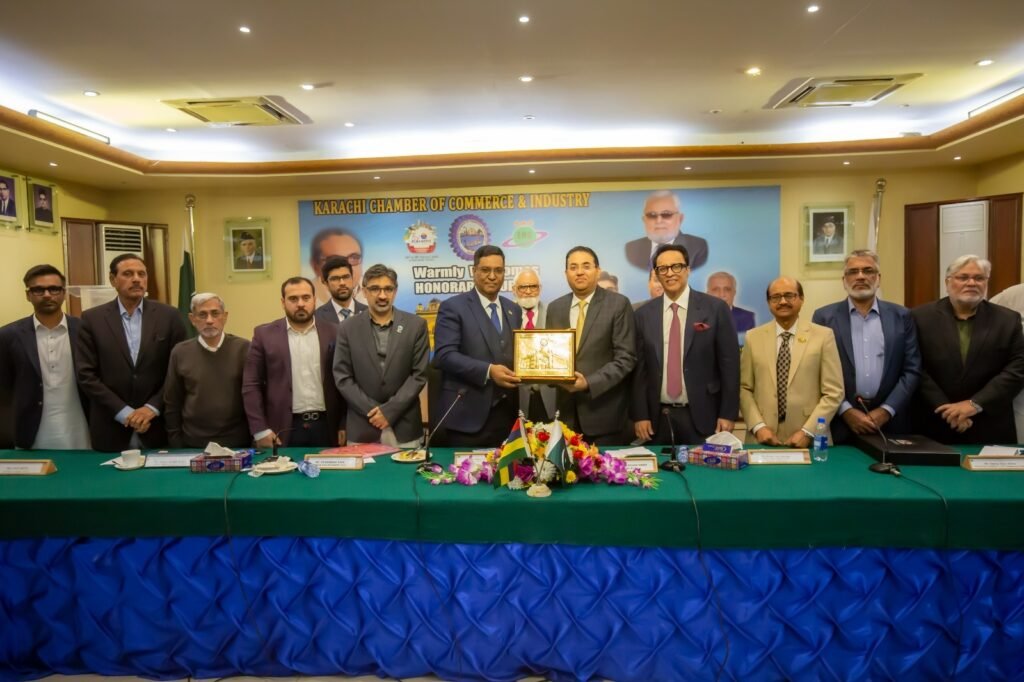
Pakistan Mauritius Preferential Trade Agreement revival has emerged as a key priority for strengthening economic ties between the two countries, as highlighted by the High Commissioner of the Republic of Mauritius, Mr. Munsoo Kurrimbaccus, during his recent visit to the Karachi Chamber of Commerce & Industry (KCCI). The agreement, which previously granted preferential market access to nearly 120 commodities, has remained inactive for years limiting the full potential of bilateral trade.
Speaking to Karachi’s business leadership, the Mauritian envoy emphasized that restoring the Pakistan Mauritius Preferential Trade Agreement could significantly boost trade volumes, diversify exports, and correct existing trade imbalances between the two economies.
Pakistan Mauritius Preferential Trade Agreement: A Strategic Economic Tool
Diplomatic relations between Pakistan and Mauritius date back to 1970, with Pakistan being the first country to establish an embassy in Mauritius after its independence. Despite historically warm relations, bilateral trade has slowed in recent years, underscoring the urgency to reactivate the Pakistan Mauritius Preferential Trade Agreement.
According to the High Commissioner, Mauritius currently imports substantially more from Pakistan than it exports, resulting in a noticeable trade imbalance. Pakistan’s major exports include Basmati rice, cement, textiles, towels, bedsheets, and other manufactured goods, while Mauritian exports to Pakistan remain limited.
Trade Imbalance Highlights the Need to Restore PTA
Under the earlier PTA framework, around 120 product categories enjoyed tariff concessions, making trade more competitive. Its suspension has reduced cost advantages and weakened supply chain linkages. Reviving the Pakistan Mauritius Preferential Trade Agreement would restore preferential access and improve price competitiveness for exporters on both sides.
Mauritius previously exported premium pineapples to Pakistan, widely regarded among the finest globally, alongside lychees and mangoes. Mauritian lychees, in particular, command premium prices in European markets such as France—outperforming competitors from Thailand and Madagascar. Renewed PTA provisions could help reintroduce these high-value products into Pakistan’s market.
Pakistan Mauritius Preferential Trade Agreement and Pharmaceutical Exports
One of the most promising areas under the Pakistan Mauritius Preferential Trade Agreement is pharmaceuticals. Pakistan manufactures high-quality medicines at nearly half the cost of European alternatives. However, regulatory recognition, certifications, and compliance requirements have limited exports to Mauritius.
The High Commissioner acknowledged Pakistan’s pharmaceutical potential and encouraged closer regulatory cooperation to unlock market access. Addressing these issues through PTA-linked frameworks could significantly expand Pakistan’s footprint in Mauritius’s healthcare sector.
Halal Food and PTA-Driven Export Opportunities
The Halal food sector presents another high-growth opportunity. Mauritius’s Muslim community maintains strict Halal standards and currently imports Halal meat primarily from Australia and India. There is strong demand for fresh Halal meat an area where Pakistani exporters could gain a competitive edge.
The Pakistan Mauritius Preferential Trade Agreement could facilitate smoother certification recognition and market entry, enabling Karachi-based exporters to tap into this lucrative segment.
Tourism, Blue Economy, and Green Growth Collaboration
Beyond traditional trade, Mauritius is positioning itself as a premium tourism destination and investing heavily in the blue and green economy. With an Exclusive Economic Zone of nearly two million square kilometers, Mauritius is focusing on aquaculture, marine biotechnology, and ocean-based pharmaceutical research.
The Mauritian High Commissioner expressed interest in collaborating with Pakistan on research, investment, and technology partnerships—areas that could be formalized through enhanced trade and investment cooperation mechanisms linked to PTA revival.
KCCI’s Role in Strengthening Pakistan–Mauritius Trade
KCCI President Muhammad Rehan Hanif reaffirmed Karachi’s business community’s readiness to work closely with the Mauritian High Commission. He highlighted Karachi’s strengths across textiles, ICT, pharmaceuticals, seafood, financial services, tourism, and joint ventures.
Recalling earlier engagements, he noted that KCCI had already offered to facilitate inspections of Pakistani meat-processing facilities by Mauritian experts to address Halal certification concerns demonstrating private-sector commitment to resolving trade barriers.
Why Pakistan Mauritius Preferential Trade Agreement Matters Now
Reviving the Pakistan Mauritius Preferential Trade Agreement is not merely about restoring past concessions it is about future-proofing bilateral trade, unlocking new sectors, and converting diplomatic goodwill into measurable economic outcomes. With growing interest from both governments and active engagement from chambers of commerce, the PTA revival could mark a new chapter in Pakistan–Mauritius economic cooperation.