
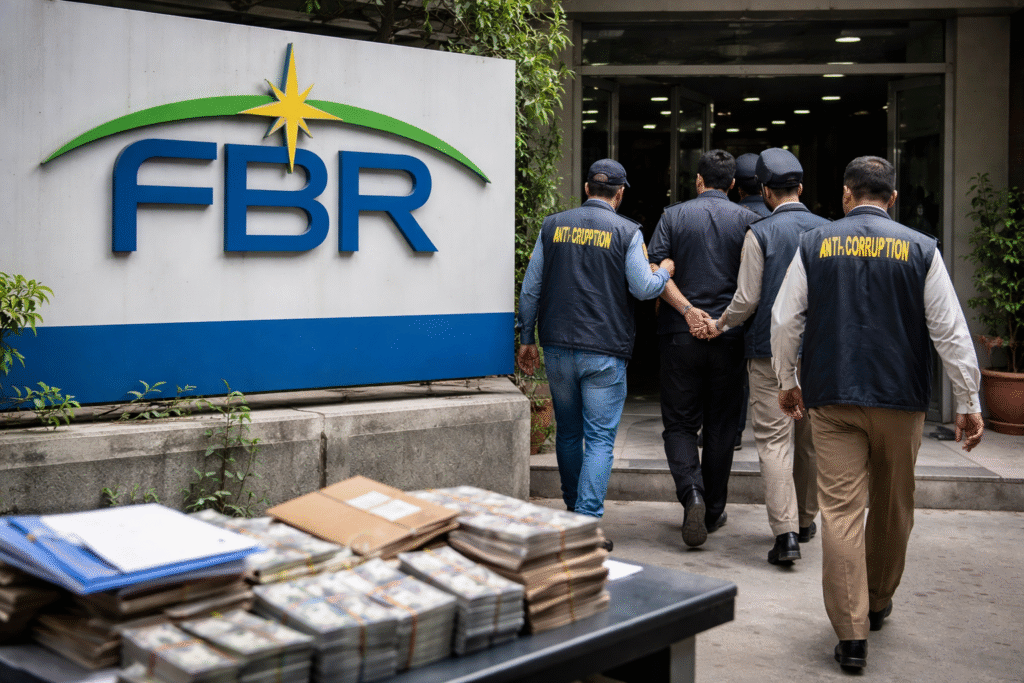
FBR corruption case developments have once again brought accountability in Pakistan’s civil service into sharp focus, as Prime Minister Shehbaz Sharif has approved the dismissal of a senior Inland Revenue Service (IRS) officer on proven corruption charges. The decision reinforces the government’s stated commitment to transparency, discipline, and institutional reform within key revenue-generating departments.
The dismissed officer, Riaz Ali Shah (BS-20), was serving as Chief (Accounting) in the Organizational Audit Wing of the Federal Board of Revenue (FBR). Although posted in Karachi, he was formally attached to the FBR headquarters in Islamabad at the time disciplinary action was finalized.
FBR Corruption Case: Background of Disciplinary Proceedings
The FBR corruption case against Riaz Ali Shah was initiated under the Civil Servants (Efficiency & Discipline) Rules, 2020, following serious allegations of inefficiency, misconduct, and corruption.
The formal process began on August 18, 2025, when an Order of Inquiry, Charge Sheet, and Statement of Allegations were issued. These documents outlined multiple violations related to misuse of authority, procedural irregularities, and conduct unbecoming of a senior public servant entrusted with financial oversight responsibilities.
Inquiry Findings in the FBR Corruption Case
To ensure procedural transparency, Zubair Bilal (IRS/BS-21) was appointed as the Inquiry Officer. After conducting a detailed examination of evidence, records, and official conduct, the inquiry report was submitted on November 12, 2025.
The findings were significant. Out of twelve charges, eleven were conclusively proven, demonstrating a sustained pattern of misconduct rather than isolated administrative lapses. Based on these findings, the inquiry officer formally recommended removal from service, categorizing the violations as serious enough to warrant the maximum disciplinary penalty.
Show Cause Notice and Opportunity of Hearing
As required under law, the accused officer was given an opportunity to defend himself. A Show Cause Notice was issued on November 19, 2025, granting ten days to submit a written response. Riaz Ali Shah submitted his reply on December 5, 2025.
To further uphold principles of natural justice, Syed Hamid Ali (PCS/BS-21) was appointed as the Hearing Officer. A personal hearing was scheduled for December 24, 2025, providing the officer a final chance to present his case in person. However, he failed to appear, weakening his defense at a critical stage of the proceedings.
Prime Minister’s Decision in the FBR Corruption Case
After reviewing the complete disciplinary record—including the charge sheet, inquiry report, show cause reply, and hearing notes—Prime Minister Shehbaz Sharif, exercising his authority under the Civil Servants (Efficiency & Discipline) Rules, 2020, approved the major penalty of dismissal from service.
The dismissal effectively ends the officer’s government career and serves as a precedent-setting action within the Federal Board of Revenue, one of Pakistan’s most strategically important institutions.
Why This FBR Corruption Case Matters
This FBR corruption case carries broader implications beyond the removal of a single officer. It sends a strong message across the civil service that rank and seniority will not shield individuals from accountability. The case also reflects growing political will to clean up governance structures, particularly in revenue and audit functions that directly impact Pakistan’s fiscal stability.
For businesses, investors, and taxpayers, such actions help restore confidence in state institutions by signaling that financial oversight bodies are being held to higher ethical standards.
Accountability at the Core of Governance Reform
The dismissal of a BS-20 IRS officer in this FBR corruption case underscores the government’s zero-tolerance stance on corruption and misconduct. As Pakistan continues to face economic and fiscal challenges, enforcing accountability within revenue authorities remains critical to strengthening governance, improving tax compliance, and rebuilding public trust.
This case stands as a clear reminder that corruption will not be tolerated at any level of public service a message with lasting implications for Pakistan’s administrative and economic future.