
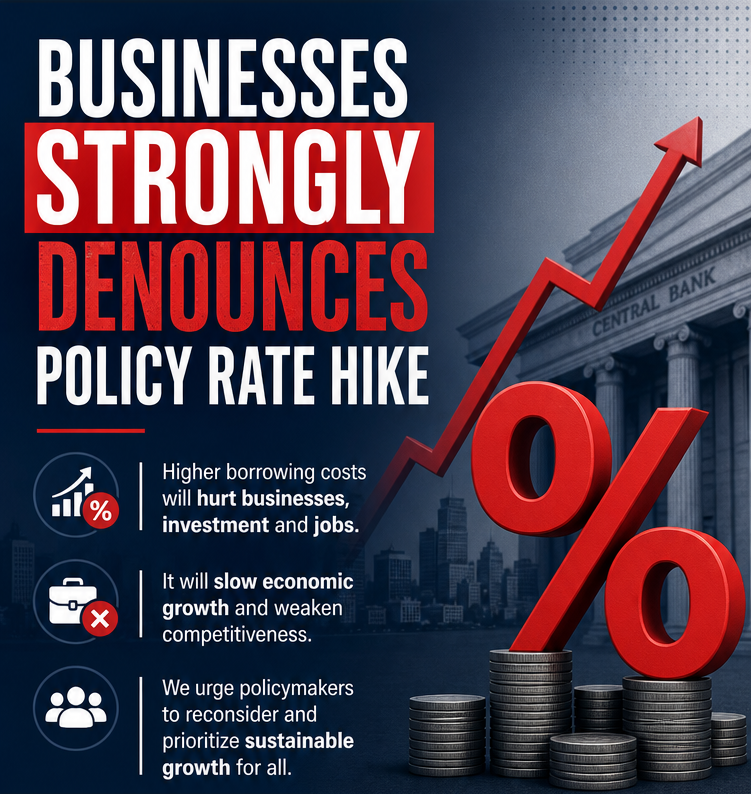
The Federation of Pakistan Chambers of Commerce & Industry (FPCCI) has strongly criticised the State Bank of Pakistan’s (SBP) latest decision to raise the policy rate by 50 basis points to 12 percent, warning that higher borrowing costs could undermine economic growth, industrial expansion and Pakistan’s export competitiveness.
FPCCI President Atif Ikram Sheikh expressed concern over the monetary tightening, describing it as counterproductive to ongoing economic stabilisation efforts. He argued that the increase would add to the financial pressure on businesses already facing high operating costs, elevated utility tariffs and liquidity constraints.
According to the FPCCI chief, businesses need affordable financing to sustain production, expand operations and generate employment rather than further increases in borrowing costs.
FPCCI Warns of Pressure on Industry and Investment
Sheikh said the latest rate increase comes at a time when manufacturers and commercial enterprises are struggling with rising operational expenses and limited access to liquidity.
He maintained that tighter monetary policy could discourage private-sector investment, restrict access to working capital and slow domestic production. Higher financing costs may also make it more difficult for businesses to maintain operations and create employment opportunities.
The FPCCI president argued that sustained high interest rates have turned borrowing from a tool for business expansion into a significant financial burden, limiting the capacity of companies to invest and grow.
Business Community Questions Inflation Control Strategy
The FPCCI president contended that Pakistan’s inflation is being driven largely by structural supply-side constraints, rising energy costs and fiscal imbalances rather than excessive aggregate demand.
He argued that increasing interest rates does little to address these underlying pressures and instead raises financing costs for productive industries.
According to Sheikh, persistent cost-push inflation requires measures that address its underlying causes. He warned that continued monetary tightening could force businesses to scale back production, delay investment or consider closing operations, without necessarily delivering the desired improvement in price stability.
FPCCI Calls for Single-Digit Interest Rates
Reiterating the organisation’s longstanding position, Sheikh urged the government and the central bank to reconsider their monetary policy approach and reduce the policy rate to single digits.
He said lower interest rates are essential to make financing more accessible for traders, small and medium-sized enterprises (SMEs) and large-scale manufacturers.
Affordable credit, he added, would help businesses upgrade technology, invest in value-added production and compete more effectively with regional rivals that benefit from lower borrowing costs.
Sheikh also highlighted the pressure that high interest rates place on debt servicing for both the government and private borrowers, arguing that expensive financing can contribute to fiscal strain and stagnant economic activity.
FPCCI Seeks Pro-Growth Monetary Policy
The FPCCI president called on the SBP, federal government and economic policymakers to adopt a forward-looking monetary framework that balances inflation management with the need to support economic growth.
He urged authorities to bring domestic interest rates closer to regional benchmarks and establish comprehensive, institutionalised consultations with the business community before introducing policies that directly affect industrial activity and national economic output.
The FPCCI’s position reflects broader concerns among businesses over the impact of borrowing costs on investment, production and exports. The debate centres on how policymakers can contain inflation while ensuring that monetary measures do not place additional pressure on an already cost-constrained private sector.