
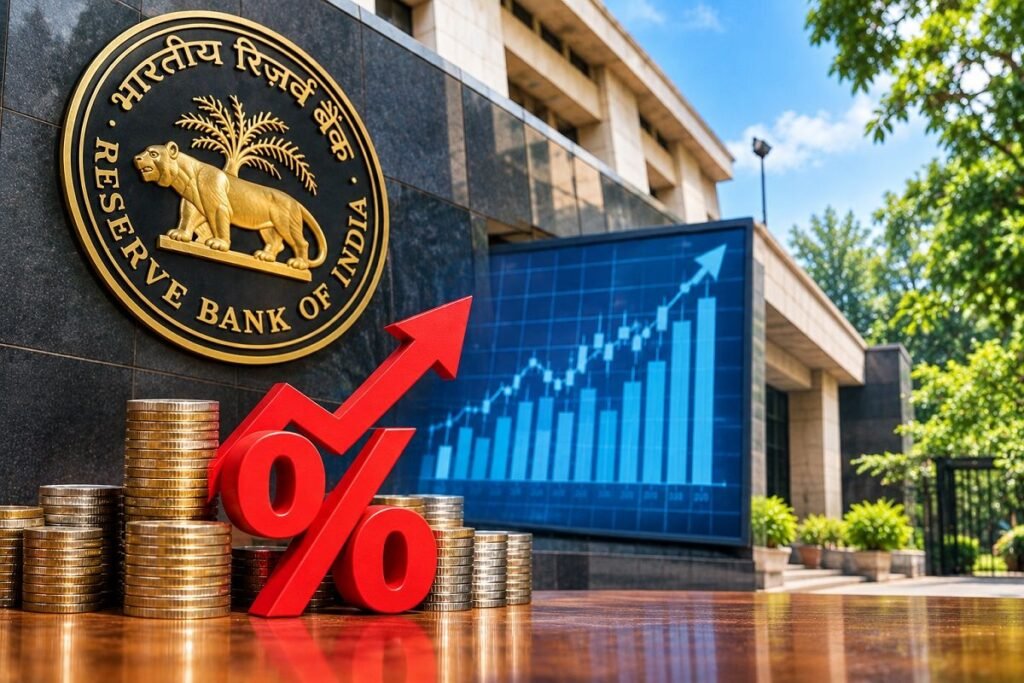
India’s central bank has raised its benchmark repo rate by 25 basis points to 5.5%, marking its first interest rate increase in nearly four years as inflationary pressures build alongside continued economic growth.
The Reserve Bank of India (RBI) also shifted its monetary policy stance from “neutral” to “calibrated tightening”, signalling that additional rate increases could remain on the table if inflation stays above the central bank’s target.
RBI Signals Scope for Further Rate Hikes
RBI Governor Sanjay Malhotra said the timing and scale of any further rate increases would depend on actual inflation and economic growth outcomes.
The decision represents a notable shift in India’s monetary policy as the central bank attempts to balance persistent inflationary pressures against an economy that continues to expand at a strong pace.
The RBI raised its inflation forecast to 5.2% from its previous estimate of 5%. Its forecast for core inflation, which excludes volatile food and fuel prices, also increased to 4.4% from 4.3%.
Inflation Moves Further Above RBI Target
India’s consumer inflation accelerated to 4.82% in August on a year-on-year basis, moving further above the RBI’s medium-term target of 4%.
Rising food and fuel costs are increasingly contributing to broader household expenses, with nearly half of the consumer basket registering inflation above 4%.
The latest rate decision indicates growing concern among policymakers that elevated inflation could persist rather than prove to be a temporary development.
Higher Rates Could Affect Demand and Investment
The 25-basis-point increase is expected to increase borrowing costs across the economy, potentially influencing consumer spending and business investment.
The RBI’s shift toward calibrated tightening suggests that monetary policy could remain restrictive if inflation continues to exceed the central bank’s target.
For businesses and households, the direction of future interest rates will depend heavily on how quickly inflation moderates and whether economic growth remains resilient under tighter financial conditions.
Bond Market Reacts to Rate Hike
India’s benchmark 10-year government bond yield increased 5 basis points to 7.2655% following the RBI announcement.
The move reflected market expectations of tighter monetary conditions as investors assessed the potential path of future interest rates and inflation.
The Indian rupee remained broadly stable at around 96.36 against the US dollar.
Indian Stocks Decline After RBI Decision
Indian equities also came under pressure following the announcement.
The Nifty 50 declined around 0.6%, while the BSE Sensex fell approximately 0.7%.
The market reaction highlights investor focus on the potential impact of higher borrowing costs on corporate earnings, consumer demand and investment activity.
Inflation and Growth Remain Key Policy Watchpoints
The RBI’s decision places greater emphasis on the trajectory of inflation in the coming months.
If price pressures remain elevated, the central bank could face continued pressure to maintain or further tighten monetary conditions. At the same time, policymakers will need to monitor whether higher interest rates begin to weigh on economic activity.
For financial markets, the balance between inflation control and economic growth is likely to remain a key driver of bond yields, the rupee and equity valuations.