
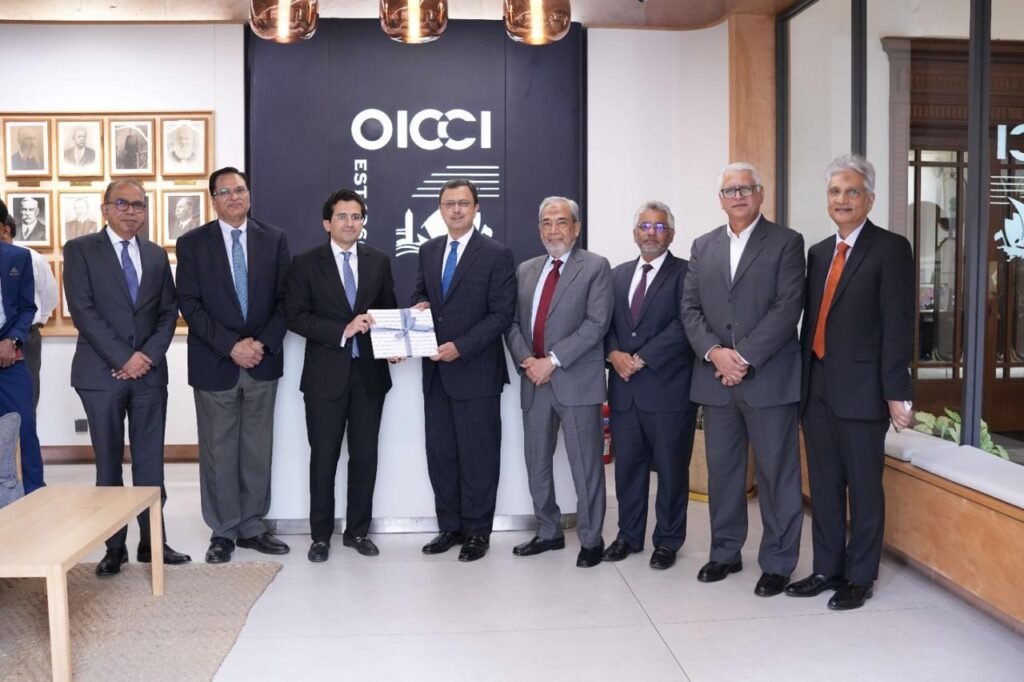
Pakistan’s petroleum sector is entering another critical phase as the government seeks fresh investment, stronger energy security and major reforms across exploration, refining and downstream markets. Federal Minister for Petroleum Ali Pervaiz Malik held separate meetings with the Overseas Investors Chamber of Commerce and Industry and Pakistan State Oil in Karachi on August 29, 2026, to discuss investment opportunities, energy security and the future direction of the sector.
The meetings come at a time when Pakistan’s petroleum industry faces a difficult combination of challenges, including heavy dependence on imported energy, refining infrastructure constraints, regulatory uncertainty and concerns over the consistency of government policies.
Pakistan Petroleum Sector Targets New Investment and Energy Security
During his visit to OICCI, Ali Pervaiz Malik met senior chamber officials, foreign investors, industry representatives and media stakeholders. The minister outlined government initiatives aimed at strengthening exploration, modernising refining infrastructure and implementing reforms throughout the petroleum value chain.
The government also highlighted bonded storage and strategic petroleum reserves as important components of its energy security strategy.
Ali Pervaiz Malik said the government’s objective is to develop a more competitive and investment-oriented petroleum sector capable of meeting Pakistan’s long-term energy requirements. He said reforms are being pursued across exploration, refining and downstream markets while the government continues consultations with industry stakeholders.
The message is significant because Pakistan’s energy security cannot depend solely on purchasing petroleum products from international markets. Any disruption in global oil prices, shipping routes or foreign exchange availability can quickly increase pressure on the country’s import bill and domestic consumers.
Pakistan Petroleum Sector Still Faces Investor Confidence Problems
The government’s engagement with foreign investors is encouraging, but dialogue alone will not solve the structural problems confronting the Pakistan petroleum sector.
OICCI members reportedly stressed the importance of policy consistency, a stable tax framework, transparency and adequate security. These concerns point toward one of the industry’s biggest weaknesses: investors require certainty before committing capital to projects that can take years to recover their investment.
Frequent changes in taxation, regulations, duties and commercial policies can significantly alter the economics of energy projects. For international investors, uncertainty itself becomes a cost.
OICCI President Yousaf Hussain welcomed the minister’s engagement with the business community and said continued dialogue could help resolve practical industry issues while supporting investment and energy security objectives.
OICCI Chief Executive and Secretary General M Abdul Aleem also stressed that predictability in the regulatory and commercial environment remains essential for foreign investors making long-term decisions.
Strategic Petroleum Reserves Could Strengthen Pakistan’s Energy Defences
The proposed expansion of strategic petroleum reserves deserves particular attention. Pakistan remains vulnerable to international oil price volatility and external supply disruptions.
A stronger reserve system could provide the country with a buffer during global supply shocks. However, building storage capacity is only one part of the solution. The government must also establish transparent rules covering reserve ownership, financing, replenishment and emergency release.
Without clear governance, strategic reserves could become another costly infrastructure initiative rather than an effective national energy security mechanism.
Refinery Modernisation Could Become a Major Investment Opportunity
Modernising Pakistan’s refining infrastructure could create opportunities for both domestic and foreign investors. New investment could improve refining efficiency, reduce dependence on imported refined products and potentially support a more competitive downstream market.
However, investors will need more than government assurances. They will look for commercially viable returns, stable taxation, transparent regulation, reliable feedstock arrangements and clear long-term energy policies.
The government’s latest engagement with OICCI therefore represents an important first step, but its real test will be implementation.
Pakistan Petroleum Sector Needs Policy Continuity, Not Just New Announcements
The latest discussions highlight a fundamental issue facing the Pakistan petroleum sector. The country has repeatedly announced energy reforms and investment initiatives, but sustained implementation remains the bigger challenge.
If Pakistan wants to attract substantial foreign capital, the government must convert consultations into measurable reforms. Investors need predictable taxation, transparent regulation, improved security, faster approvals and commercially credible energy policies.
The petroleum sector is too important to Pakistan’s economy to be managed through short-term measures alone. Energy security, refinery investment and exploration require long-term planning and institutional consistency.
The government’s engagement with OICCI and PSO could therefore prove meaningful if it leads to concrete policy changes. Otherwise, the meetings risk becoming another round of consultations without producing the investment transformation Pakistan urgently needs.