
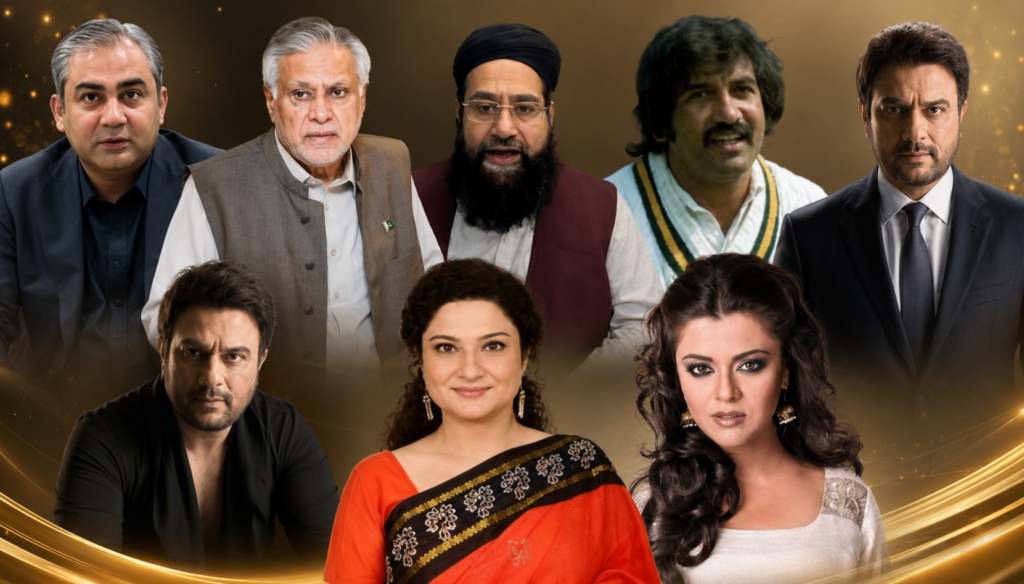
Pakistan has announced one of its largest civil honours lists, with President Asif Ali Zardari approving 355 Pakistan Civil Awards for Pakistani citizens and foreign nationals in recognition of their contributions to public service, administration, diplomacy, literature, medicine, business and other fields.
The awards, approved on the occasion of Pakistan’s 78th Independence Day, are scheduled to be formally presented on Pakistan Day, March 23.
The sheer size of the list has already placed the Pakistan Civil Awards under public scrutiny. While recognising national service is an important state responsibility, such a long list also raises a broader question: how effectively does the civil awards system distinguish extraordinary national contributions from routine official responsibilities?
Pakistan Civil Awards Include Ishaq Dar and Mohsin Naqvi
Among the most prominent recipients of the Nishan-i-Imtiaz are Deputy Prime Minister and Foreign Minister Mohammad Ishaq Dar, Federal Finance Minister Muhammad Aurangzeb, Interior Minister Mohsin Naqvi, Federal Minister Ahad Khan Cheema, Prime Minister’s Coordinator Bilal Azhar Kayani, and renowned poet and writer Asad Muhammad Khan.
The inclusion of senior serving ministers makes the announcement particularly significant. Government officials already operate in positions carrying substantial authority and public responsibility. The award system therefore faces the challenge of demonstrating that recipients are being recognised for exceptional achievements rather than simply holding influential offices.
That distinction matters because civil awards derive their credibility from public confidence in the selection process.
FBR Chairman, IB Director General and AGP Receive Hilal-i-Imtiaz
The Hilal-i-Imtiaz list includes several senior officials who occupy critical positions in Pakistan’s state machinery.
Among them are Rashid Mahmood Lagrial, Chairman of the Federal Board of Revenue, Fuad Asadullah, Director General of the Intelligence Bureau, Mansoor Usman Awan, Attorney General for Pakistan, Imdadullah Bosal, Federal Finance Secretary, and Barrister Nabeel A. Awan, Establishment Secretary.
The recognition of officials from taxation, intelligence, law and financial administration gives the awards a strong public-sector focus. However, it also highlights the need for greater transparency around the criteria used to evaluate senior bureaucrats and public office holders.
The awards will carry greater legitimacy if citizens can clearly understand what specific achievements led to each honour.
Business, Medicine, Literature and Overseas Pakistanis Also Honoured
The list extends beyond government circles. Dr. Shahid Mahmud, CEO of Interactive Group, Lt. Gen. retired Moazzam Ejaz, Rector of NUTECH, transplant surgeon Dr. Faisal Saud Dar, media pioneer Sultana Siddiqi, and poets Ejaz Rahim and Khurshid Ul Hasan Rizvi are among those receiving recognition.
Overseas Pakistanis are also represented, including Dr. Ghulam Murtaza from the United Kingdom, Professor Ahmed Ali, late, from China, and Sardar Muhammad Ilyas Khan from Saudi Arabia.
Foreign nationals have also been included in the honours. Sheikha Fatima bint Mubarak of the UAE has been awarded the Nishan-i-Pakistan, while senior figures from Saudi Arabia, Russia, Türkiye and Spain have received various state honors.
Why Pakistan Civil Awards Need Greater Transparency
The Pakistan Civil Awards are intended to celebrate exceptional service, but the credibility of any national honours system depends on how convincingly it separates extraordinary achievements from institutional responsibilities.
The government could strengthen public confidence by publishing clearer explanations for major awards, including the specific contribution, measurable impact and public benefit associated with each recipient.
Without such transparency, even deserving recipients can face unnecessary controversy because the public is left to speculate about why particular names were selected.
The March 23 ceremony will therefore be more than a formal presentation. It will also test whether Pakistan’s civil honours system can balance recognition, merit and public accountability while celebrating those who have genuinely contributed to the country’s progress.