
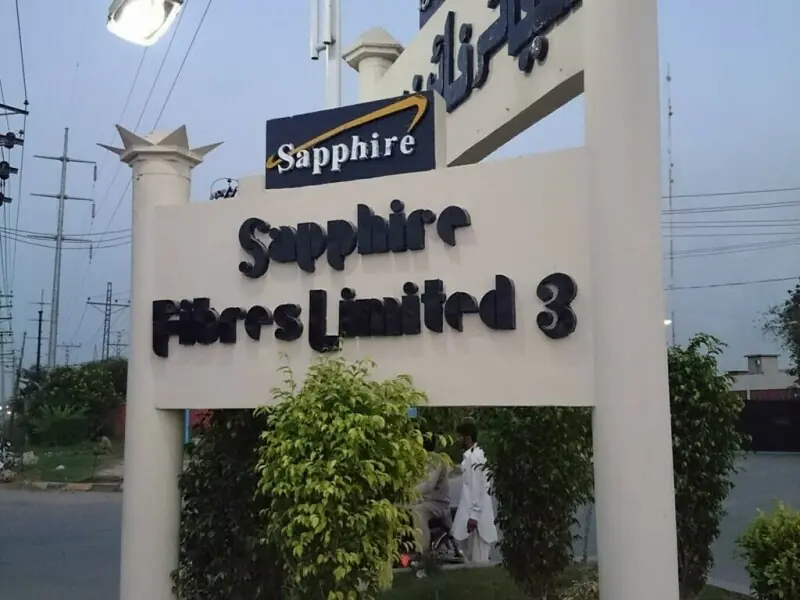
Sapphire Fibres Limited has entered the race for the privatisation of Faisalabad Electric Supply Company, a development that could bring a major industrial player into one of Pakistan’s most closely watched power-sector transactions.
The company, listed on the Pakistan Stock Exchange as PSX: SFL, has secured the Request for Statement of Qualification issued by the Privatisation Commission for the proposed divestment of FESCO. The development signals growing corporate interest in acquiring a stake in a major electricity distribution company at a time when Pakistan is under increasing pressure to improve the financial and operational performance of its power sector.
Sapphire Fibres and FESCO Privatisation Move
Sapphire Fibres Limited’s Board of Directors has approved the company’s participation in the FESCO privatisation process. However, the approval does not mean that Sapphire Fibres has secured the electricity distribution company.
The company still needs to qualify under the Privatisation Commission’s pre-qualification process and obtain all necessary corporate and regulatory approvals before moving forward.
Sapphire Fibres has also indicated that it may form a consortium after receiving the required approval. This could become an important factor in the transaction because acquiring and restructuring a large power distribution company requires substantial financial resources, technical expertise and long-term operational capacity.
The company has further committed to informing the Pakistan Stock Exchange about material developments related to the transaction.
Why FESCO Privatisation Matters to Pakistan’s Power Sector
The proposed privatisation of FESCO is more than a corporate acquisition. It is part of a broader effort to reduce the government’s role in electricity distribution and improve the performance of distribution companies.
FESCO operates across Faisalabad and surrounding areas, including major industrial and commercial zones. Its customer base and connection to one of Pakistan’s key industrial regions make the company strategically important.
For potential investors, however, the attraction comes with serious challenges. Electricity distribution companies have historically faced issues involving transmission and distribution losses, electricity theft, inefficient billing, recoveries and regulatory constraints.
This means the real value of FESCO cannot be judged simply by its customer base or existing financial position. Any successful buyer will have to determine whether operational reforms can generate sustainable returns.
Sapphire Fibres FESCO Bid Faces Major Questions
The entry of Sapphire Fibres raises an important question: can an industrial group bring the efficiency required to transform a large public-sector power distributor?
The answer will depend heavily on the final privatisation structure.
A private owner could potentially introduce stronger financial controls, improve collection systems, invest in technology and reduce operational inefficiencies. However, privatisation alone does not guarantee better service or lower electricity costs.
The government and regulators will need to ensure that the transaction does not simply transfer a public-sector monopoly into private hands without adequate accountability.
Consumers will ultimately judge the success of the FESCO privatisation through service reliability, billing accuracy, complaint resolution and electricity costs rather than through the size of the acquisition price.
FESCO Privatisation Could Test Pakistan’s Reform Strategy
The FESCO privatisation process could become a test case for Pakistan’s broader strategy of restructuring the power distribution sector.
Sapphire Fibres’ decision to participate indicates that private-sector investors see potential in the opportunity. But investors will also scrutinize regulatory policies, tariff mechanisms, receivables, power-sector circular debt and the government’s ability to provide a predictable operating environment.
The biggest risk is that expectations surrounding privatisation become larger than the reforms actually delivered.
If FESCO is successfully transformed, the transaction could strengthen confidence in Pakistan’s privatisation programme and demonstrate that distribution companies can be operated more efficiently. If structural problems remain unresolved, however, private ownership may only shift responsibility without solving the underlying weaknesses.
For now, Sapphire Fibres has only secured the opportunity to enter the qualification process. The more significant battle will come later, when potential investors assess FESCO’s financial condition, operational risks and future profitability.
The next stages of the FESCO privatisation process will therefore be closely watched by investors, industrial groups and electricity consumers alike.