
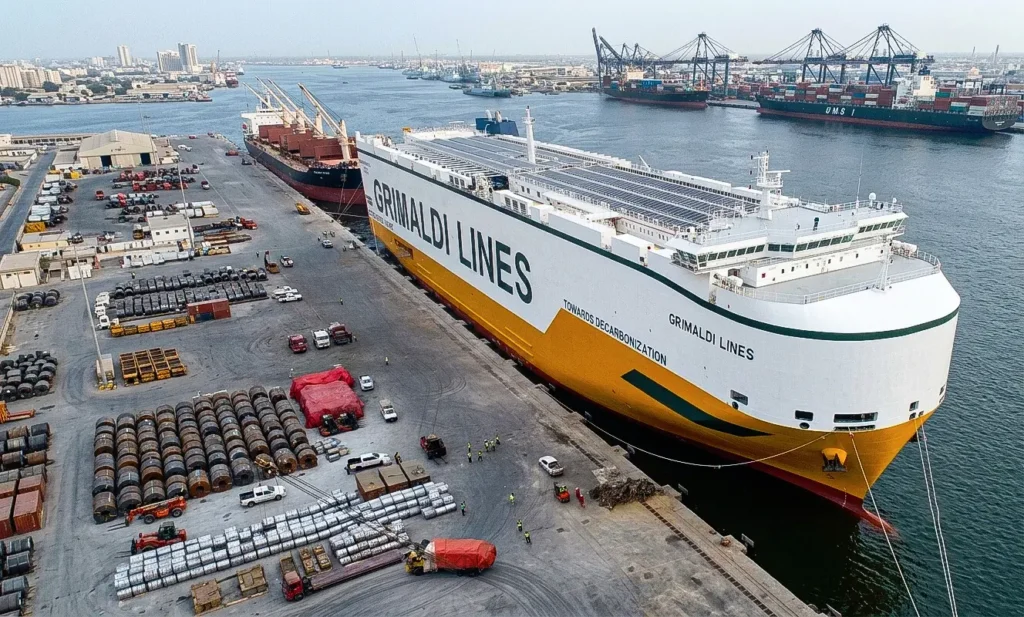
Pakistan has entered a new chapter in maritime logistics after the country received its First RoRo Vessel carrying more than 2,000 electric vehicles (EVs), marking the debut of the specialized roll-on/roll-off shipping service for automobile imports.
The milestone was achieved with the arrival of M.V. Grande Shanghai at the Karachi Gateway Terminal Limited (KGTML), located at Karachi Port. Unlike conventional vehicle shipments transported in containers, the electric vehicles were driven directly off the vessel using built-in ramps, eliminating the need for cranes and significantly reducing unloading time.
The First RoRo Vessel operation is being viewed as a major step toward modernizing the country’s maritime infrastructure and improving the efficiency of automobile imports.
Federal Minister for Maritime Affairs Junaid Anwar Chaudhry described the arrival as a landmark achievement for Pakistan’s shipping industry and an important milestone in the government’s broader efforts to upgrade port operations.
“This marks the beginning of a new era for Pakistan’s maritime sector,” the minister said, adding that the adoption of RoRo shipping demonstrates the country’s commitment to aligning its ports with international standards.
What Is RoRo Shipping?
Roll-on/roll-off (RoRo) shipping is a specialized method of transporting wheeled cargo, including passenger vehicles, trucks, buses, construction equipment, and heavy machinery.
Instead of using cranes to lift cargo into containers, vehicles are simply driven onto and off the ship through built-in ramps.
The system significantly reduces loading and unloading times while lowering handling costs and minimizing the risk of cargo damage.
Globally, RoRo vessels are widely used by automobile manufacturers because they provide a faster and more efficient way to transport large numbers of vehicles across international markets.
With the arrival of Pakistan’s First RoRo Vessel, Karachi Port has joined a network of international ports capable of handling this specialized shipping service.
Karachi Port Moves Toward Global Standards
According to the Maritime Affairs Ministry, introducing RoRo operations represents another important step in modernizing Pakistan’s port infrastructure.
Minister Chaudhry said investments in modern cargo handling facilities will improve operational efficiency, reduce vessel turnaround times, and strengthen Pakistan’s competitiveness in regional trade.
He added that adopting international shipping practices would support the country’s long-term trade ambitions while making Karachi Port more attractive to global shipping companies.
“Karachi Port is moving toward world-class, modern shipping services,” the minister said.
The ministry believes the new service will improve logistics performance while facilitating smoother imports of vehicles and heavy equipment in the future.
Boost for Electric Vehicle Imports
The arrival of more than 2,000 electric vehicles also reflects growing interest in Pakistan’s emerging EV market.
As consumers increasingly shift toward cleaner transportation technologies, efficient shipping methods such as RoRo services are expected to support larger vehicle imports while reducing overall logistics costs.
Industry observers say improved port handling capabilities could encourage additional international automakers to expand their presence in Pakistan.
The ability to unload vehicles directly from ships also minimizes handling requirements, allowing importers to move inventory more quickly into the domestic market.
Part of Broader Maritime Modernization
The successful RoRo operation follows several other significant developments across Pakistan’s ports as authorities continue investing in maritime infrastructure and logistics capabilities.
The government has identified port modernization as a key component of its strategy to improve trade facilitation, reduce shipping costs, and strengthen Pakistan’s position as a regional logistics hub.
Officials believe modern cargo handling systems will improve supply chain efficiency while supporting future growth in imports and exports.
Recent LNG Operation Highlighted Port Capabilities
The RoRo milestone comes only days after Pakistan successfully completed another high-profile maritime operation at Port Qasim.
Despite severe monsoon weather and hazardous sea conditions, authorities safely berthed a liquefied natural gas (LNG) carrier through Port Qasim’s 49-kilometre navigational channel, preventing potential disruptions to the country’s energy supplies.
The Port Qasim Authority described the operation as a historic achievement that demonstrated Pakistan’s growing maritime capabilities under difficult operating conditions.
The vessel transported approximately 171,951 cubic metres of LNG, making it the largest LNG cargo ever handled at the PGPCL terminal.
With a beam of 47.8 metres, the ship also became the widest LNG carrier ever accommodated at Port Qasim during the monsoon season.
The successful operation highlighted improvements in navigation, pilotage, and port management while reinforcing confidence in Pakistan’s ability to handle increasingly complex maritime operations.
Strengthening Pakistan’s Logistics Network
The introduction of RoRo shipping is expected to strengthen Pakistan’s logistics network by offering importers a faster, safer, and more cost-effective method of transporting vehicles and heavy machinery.
Industry experts believe the service will reduce congestion, shorten cargo clearance times, and improve supply chain efficiency for automobile importers.
The government also expects the development to attract additional shipping lines offering specialized maritime services, helping Pakistan integrate more closely with global trade routes.