
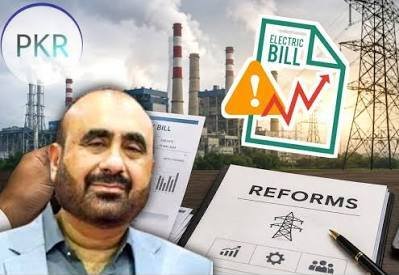
Pakistan’s electricity consumers continue to bear the financial burden of years of inefficiency, delayed reforms, and weak governance in the power sector, according to Khurram Ijaz, Secretary General of the Businessmen Panel Progressive (BMPP) and former Vice President of the Federation of Pakistan Chambers of Commerce & Industry.
Referring to the Auditor General of Pakistan (AGP) Audit Report 2025-26, Ijaz urged the federal government to immediately review the Debt Service Surcharge (DSS), arguing that the Rs3.23-per-unit levy unfairly shifts the cost of institutional failures onto households and businesses.
Debt Service Surcharge Under Fire
Ijaz said the AGP report highlights a troubling reality in Pakistan’s power sector, where consumers continue to shoulder the financial burden instead of seeing meaningful structural reforms.
He argued that the government has relied on surcharges and borrowing to manage the sector’s financial problems rather than addressing the underlying causes of inefficiency.
“The audit lays bare an uncomfortable reality: instead of fixing the power sector, consumers are repeatedly being asked to pay for its failures,” he said.
AGP Report Questions Effectiveness of Power Sector Reforms
According to Ijaz, the audit exposes a significant gap between the government’s reform agenda and the actual performance of the electricity sector.
While the National Electricity Policy and National Electricity Plan (2023-27) aim to create a competitive, financially sustainable, and consumer-focused electricity market, the audit found that the sector recorded average deficits of 2.8 percent of GDP between FY2014 and FY2024.
He noted that although circular debt declined from Rs2.39 trillion in June 2024 to Rs1.61 trillion by June 2025, the reduction resulted primarily from commercial borrowing and fiscal interventions rather than genuine structural reforms.
According to Ijaz, borrowing merely postpones the crisis while electricity consumers continue paying higher tariffs.
High Transmission Losses Continue to Drive Circular Debt
The AGP report also highlighted persistent operational inefficiencies across public-sector electricity distribution companies (DISCOs).
During FY2024-25:
- Transmission and distribution (T&D) losses reached nearly Rs265 billion.
- Poor recoveries added another Rs132 billion to sector losses.
Ijaz said these figures demonstrate that the root causes of Pakistan’s circular debt remain unresolved.
He argued that electricity theft, technical losses, weak recoveries, and poor governance continue despite repeated promises of reform.
K-Electric Consumers Face Fairness Questions
Ijaz also referred to the AGP’s observations regarding the application of the Debt Service Surcharge to customers of K-Electric.
He said the audit questioned the fairness of imposing the surcharge on K-Electric consumers despite the utility not contributing to Pakistan’s circular debt.
According to him, the issue raises broader concerns regarding transparency, consumer rights, and equitable tariff policies.
Electricity Theft and Billing Issues Remain Major Challenges
The AGP report found that actual transmission and distribution losses climbed to 17.55 percent during FY2024-25, well above the 11.77 percent benchmark approved by the National Electric Power Regulatory Authority.
Ijaz attributed the higher losses to:
- Electricity theft
- Defective metering
- Inaccurate billing
- Delayed bill recoveries
He added that persistent overbilling complaints and billing inaccuracies have further weakened public confidence in electricity distribution companies.
Weak Transmission Network Raises Costs
Ijaz also criticized Pakistan’s ageing transmission infrastructure, saying it contributed to approximately Rs1.9 trillion in capacity payments during FY2024-25.
He argued that delays in upgrading the transmission network have prevented the country from fully utilizing available electricity generation, forcing consumers to pay for idle capacity.
While welcoming the government’s proposed 800MW market allocation and wheeling initiative, he said the measure remains too limited to introduce meaningful competition or reduce reliance on Pakistan’s single-buyer electricity model.
Call for Comprehensive Power Sector Reforms
Ijaz stressed that Pakistan’s industrial competitiveness cannot improve while electricity tariffs continue reflecting inefficiencies instead of actual production costs.
He urged the federal government to:
- Review the Debt Service Surcharge.
- Reform electricity tariff structures.
- Strengthen governance of DISCOs.
- Intensify anti-electricity theft measures.
- Accelerate transmission infrastructure upgrades.
- Improve billing and recovery systems.
- Expand private sector participation in the power sector.
He concluded that lasting reforms—not temporary fiscal measures—are essential to protect consumers and place Pakistan’s electricity sector on a financially sustainable path.