
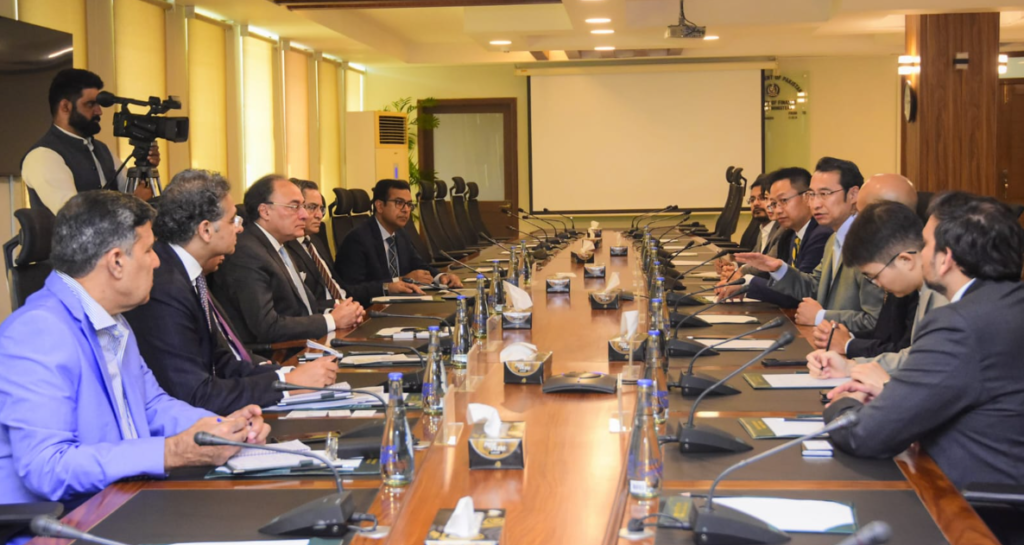
Pakistan’s ambitions to become a major player in the electric vehicle industry are receiving a significant boost as Chinese automotive giant BYD and Mega Motor Company intensify their expansion plans. The latest meeting between Federal Minister for Finance and Revenue Senator Muhammad Aurangzeb and senior executives from BYD Group and Mega Motor Company signals growing confidence in Pakistan’s potential to emerge as a regional center for electric vehicle manufacturing and exports.
The discussions highlighted a broader vision that goes beyond vehicle sales and aims to establish a complete ecosystem for electric mobility in the country.
BYD Pakistan EV Investment Moves Beyond Vehicle Imports
The delegation, led by BYD Group Vice President Liu Xueliang and Mega Motor Company CEO Aly Khan, briefed the government on the progress of BYD’s manufacturing facility in Pakistan. According to the company, development of the plant is proceeding according to schedule, marking an important milestone for the country’s automotive sector.
BYD also unveiled plans to accelerate localization efforts, expand its vehicle lineup and introduce advanced charging solutions. The company aims to create an ecosystem capable of supporting long-term growth rather than relying solely on imported vehicles.
Finance Minister Muhammad Aurangzeb welcomed the initiative, emphasizing that technology-driven investments are becoming increasingly important for Pakistan’s economic transformation.
Pakistan Emerges as a Strategic Market for BYD
Mega Motor Company CEO Aly Khan informed the meeting that Pakistan occupies a strategic position in BYD’s global expansion strategy. The company is pursuing a phased localization plan designed to increase domestic sourcing and strengthen partnerships with local vendors.
This approach could create new opportunities for Pakistani manufacturers and suppliers while reducing dependence on imports. It also has the potential to strengthen the country’s automotive supply chain and generate employment opportunities for engineers, technicians and skilled workers.
BYD Pakistan EV Investment Includes Charging Infrastructure Expansion
One of the biggest hurdles to electric vehicle adoption remains the availability of charging stations. Recognizing this challenge, BYD and Mega Motor Company are working with local partners to develop a nationwide charging network.
Executives also shared plans to launch training programs for engineers and technical staff to support the growing EV industry.
Government officials stressed that without adequate charging infrastructure, large-scale electric vehicle adoption would remain difficult. They encouraged the companies to speed up investment in local assembly and charging facilities.
Plug-In Hybrid Vehicles Could Become Pakistan’s Transition Technology
The two sides also discussed the future role of plug-in hybrid electric vehicles. Drawing on international experience, BYD executives explained that plug-in hybrids could serve as a bridge technology in countries where charging infrastructure is still evolving.
Pakistan’s rapidly expanding solar energy sector could further support electric mobility. Experts believe the combination of renewable energy and electric vehicles could significantly reduce fuel import dependence and promote sustainable transportation.
China-Pakistan Cooperation Could Reshape the Auto Industry
As global demand shifts toward cleaner mobility, Pakistan appears determined not to be left behind. Improved macroeconomic conditions and greater emphasis on sustainable industrialization have created a more favorable environment for foreign investment.
The BYD Pakistan EV Investment initiative represents more than just another automotive project. It reflects a larger effort to position Pakistan as a regional hub for new energy vehicles, advanced manufacturing and technological innovation.
If executed successfully, the partnership between BYD and Mega Motor Company could redefine Pakistan’s automotive landscape, create thousands of jobs, encourage technology transfer and place the country firmly on the map of the global electric mobility revolution.