
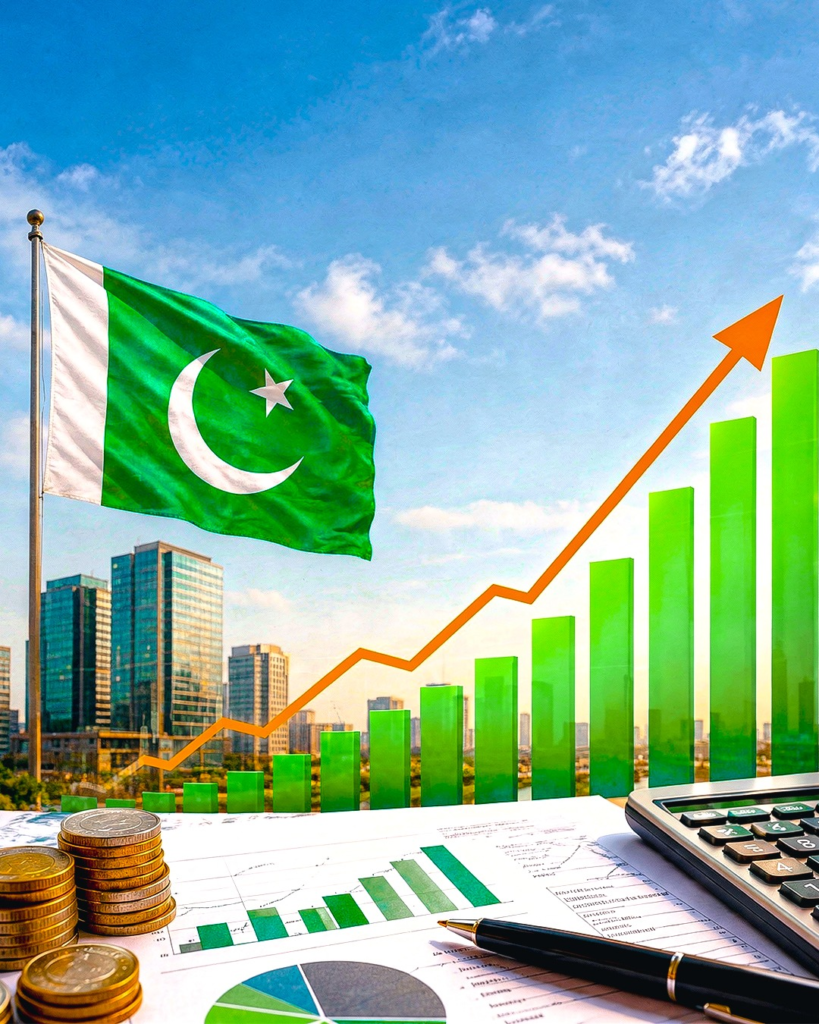
Islamabad: The government has announced a 4% GDP growth target for the fiscal year 2026-27, marking a modest uptick from the 3.7% growth recorded in the outgoing year. This projection comes as part of the Annual Plan 2026-27, released on Friday, highlighting resilience despite challenges like monsoon floods and geopolitical tensions in the Middle East.
Sectoral Drivers of Economic Expansion
Fiscal Discipline and Development Priorities
The overall 4% growth in FY27 is expected to be supported by an increase of 3.6% in the agriculture sector, 4.5% in industry, and 4.2% in services. In comparison, FY26 saw agriculture grow by 2.9%, industry by 3.5%, and services by 4.1%. Officials noted that the economy maintained an upward trajectory in FY 2025-26 despite external shocks.
Agriculture remains a cornerstone of Pakistan’s economy, employing a large portion of the workforce and contributing significantly to exports. The targeted 3.6% growth reflects optimism around improved irrigation, better seed varieties, and recovery from recent floods. However, experts caution that climate variability could pose risks if monsoon patterns remain erratic.
Industry is projected to expand at 4.5%, driven by potential improvements in manufacturing and construction. Enhanced business confidence, supported by political stability and macroeconomic measures, could attract more investment in this sector. Large-scale manufacturing and small and medium enterprises (SMEs) are expected to play key roles.
Services, which already posted 4.1% growth last year, are slated for 4.2% expansion. This includes wholesale and retail trade, transport, finance, and IT-related activities. Digital economy initiatives and financial inclusion efforts may further bolster this sector.
“The economy remained on an upward growth trajectory (in FY 2025-26), despite monsoon floods and the Middle East conflict,” the Annual Plan stated. This resilience underscores the effectiveness of recent stabilization policies.
Inflation is forecast to average 8.2% in FY27, up from 7.1% in FY26. Rising fuel costs linked to Middle East tensions and external supply shocks are cited as primary reasons. The government aims to manage this through targeted subsidies and monetary policy coordination with the State Bank of Pakistan.
Investment-to-GDP ratio is targeted at 15%, up from previous levels, fueled by better business climate and stability. National savings are projected at 14.3% of GDP, benefiting from financial sector deepening and a stable current account.
The total national development outlay for FY27 stands at Rs3.675 trillion. Federal ministries and divisions will receive Rs1 trillion, while provincial Annual Development Plans (ADPs) get Rs2.224 trillion. Federal state-owned enterprises are allocated Rs451 billion. This is lower than the Rs4.224 trillion approved for FY26, reflecting a more cautious fiscal approach amid resource constraints.
Sector-wise PSDP Breakdown
Infrastructure projects will receive the largest share at Rs603 billion, critical for roads, energy, and water resources. Social sector allocation is Rs181 billion, focusing on health and education. Governance gets Rs13 billion, science and IT Rs41 billion, and special areas including AJK, Gilgit-Baltistan, and merged districts see combined support of Rs145 billion. Production and other sectors receive smaller portions.
Analysts view the plan as balanced but stress the need for efficient execution. Completion of ongoing projects rather than new launches is expected to maximize impact.
Challenges persist, including external risks like oil price volatility. Sustained reforms in taxation, energy, and governance will be vital to achieve these targets.
Private sector participation is encouraged through improved ease of doing business. Foreign direct investment inflows could accelerate if political stability holds.
Overall, the FY27 plan signals continuity in recovery while addressing structural issues. Success will depend on implementation and global economic conditions.