
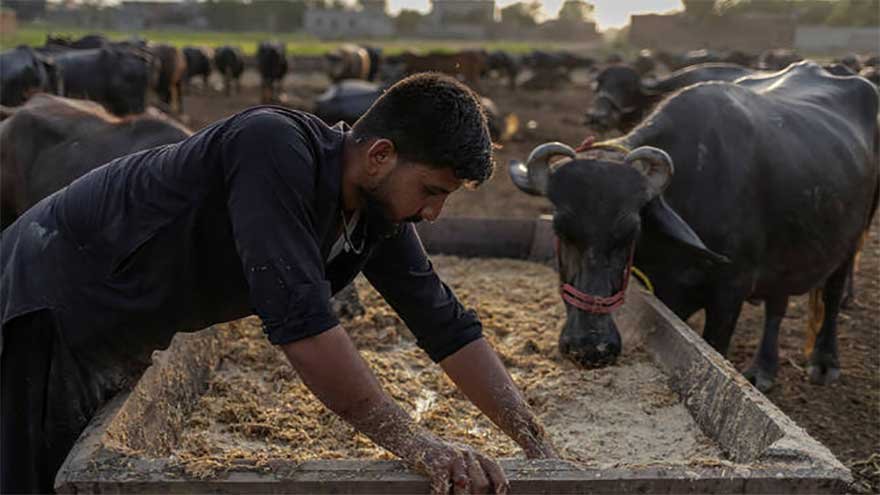
Pakistan buffalo genetic material exports have entered a new era after Islamabad and Beijing signed a landmark agreement that could redefine the future of the country’s livestock industry. Long overshadowed by traditional export sectors, Pakistan’s prized buffalo genetics are now being positioned as a high-value commodity capable of generating millions of dollars in foreign exchange.
The development is not merely another bilateral agreement. It signals Pakistan’s entry into the rapidly expanding global market for advanced animal genetics.
Pakistan Buffalo Genetic Material Exports Open a New Revenue Stream
Pakistan and China have signed a historic Material Transfer Agreement (MTA) that paves the way for the export of buffalo embryos, semen and sexed semen to the Chinese market.
Under the agreement, China’s Royal Group has established a modern embryo, semen and ova production facility in Pakistan. The facility will collect, process and prepare buffalo genetic material for exports, creating a specialized value chain that did not previously exist at this scale within the country.
Initial imports under the arrangement are estimated at around $5 million. However, the bigger story lies in future projections. Officials expect annual exports to reach approximately $25 million, creating a steady stream of foreign exchange earnings for Pakistan.
For a country struggling with recurring balance-of-payment pressures, even niche export sectors are gaining strategic importance.
Why Pakistan’s Buffalo Genetics Are Suddenly in Global Demand
At the center of this opportunity is Pakistan’s renowned Nili-Ravi buffalo breed.
Known internationally for its exceptional milk production and superior genetic traits, the breed has long been regarded as one of Pakistan’s most valuable yet underutilized biological assets.
For decades, Pakistan exported dairy products and livestock on a limited scale while overlooking the commercial potential of its genetic resources. The China agreement changes that equation.
Instead of exporting only conventional agricultural products, Pakistan is moving up the value chain by exporting intellectual biological assets that command significantly higher returns.
The strategy could eventually establish Pakistani buffalo genetics as a globally recognized brand.
The Hidden Battle to Protect Pakistan’s Genetic Wealth
The agreement also addresses a concern that experts have repeatedly raised: protecting national genetic resources from exploitation.
The Material Transfer Agreement functions as a legal safeguard mechanism. It ensures controlled access to buffalo genetics, regulates transfers and prevents unauthorized use or commercial misuse by external parties.
Importantly, the framework protects Pakistan’s intellectual property rights linked to its buffalo genetic resources.
This aspect of the agreement may prove just as significant as the expected export revenues.
Without proper protections, countries risk losing ownership and control over valuable indigenous genetic assets that can later generate enormous profits elsewhere.
Diplomatic Efforts Behind the Breakthrough
The agreement was finalized through sustained diplomatic, technical and regulatory engagement led by Federal Minister for National Food Security and Research Rana Tanveer Hussain and Animal Husbandry Commissioner Dr. Syed Murtaza Hassan Andrabi.
Their efforts involved close coordination with Chinese authorities to establish protocols acceptable to both countries.
The successful conclusion of the negotiations highlights how agricultural diplomacy is increasingly becoming an economic tool rather than merely a technical exercise.
Pakistan Buffalo Genetic Material Exports Could Redefine Livestock Economics
Pakistan’s livestock sector contributes significantly to the agricultural economy and supports millions of rural households. Yet much of its potential remains untapped.
The China agreement introduces a new business model where scientific innovation, biotechnology and genetics become drivers of export growth.
If managed effectively, the initiative could encourage investment in breeding programs, veterinary services, research institutions and modern livestock infrastructure.
It may also inspire policymakers to identify other indigenous assets with export potential beyond traditional commodities.
For now, the message is clear. Pakistan is no longer selling only livestock products. It is beginning to commercialize knowledge, genetics and innovation.
That transition could transform the country’s buffalo industry from a domestic agricultural success story into a globally competitive export enterprise.
Pakistan buffalo genetic material exports represent more than a trade deal with China. They reflect a strategic shift toward higher-value exports built on indigenous strengths. The projected revenues may appear modest compared with major industries, but the long-term implications are substantial.
If protected, promoted and expanded, Pakistan’s buffalo genetics could emerge as one of the country’s most surprising export success stories in the years ahead.