
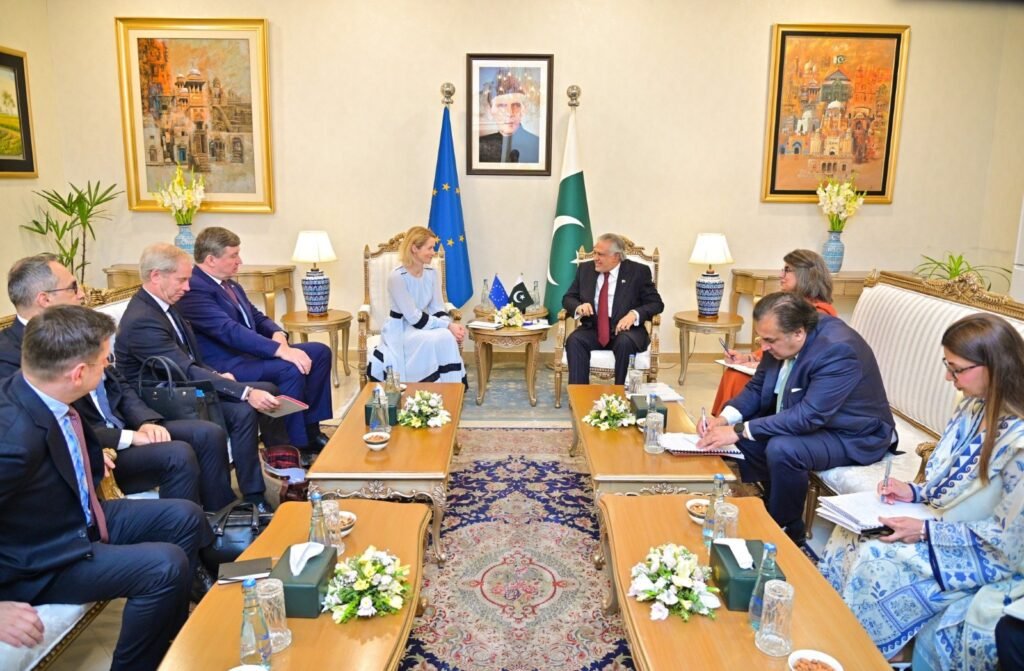
The Pakistan EU Strategic Dialogue has emerged as a major diplomatic and economic development, with both Pakistan and the European Union expressing strong interest in transforming their relationship into a broader and more ambitious partnership.
During the 8th Pakistan-EU Strategic Dialogue in Islamabad, Deputy Prime Minister and Foreign Minister Ishaq Dar and European Union foreign policy chief Kaja Kallas highlighted significant untapped opportunities that could reshape economic, political and strategic cooperation between the two sides.
The meeting comes at a time when global trade routes, geopolitical alliances and economic partnerships are rapidly evolving, making stronger Pakistan-EU cooperation more important than ever.
Pakistan Sees Untapped Potential in EU Partnership
Speaking at the high-level dialogue, Ishaq Dar emphasized that Pakistan’s relationship with the European Union has a strong foundation but remains far from reaching its full potential.
According to Dar, several sectors offer opportunities for deeper engagement, particularly trade, investment, economic development and institutional cooperation.
The foreign minister stressed that both sides should maintain regular strategic dialogues to ensure continuous progress and stronger diplomatic coordination.
His remarks reflected Islamabad’s growing desire to diversify international partnerships and attract foreign investment amid challenging global economic conditions.
Pakistan EU Strategic Dialogue Focuses on Long-Term Vision
One of the most significant developments emerging from the dialogue was Pakistan’s proposal for a comprehensive strategic vision designed to guide future cooperation.
Building upon the Strategic Engagement Plan of 2019 and the Cooperation Agreement signed in 2004, Pakistan aims to create a more forward-looking framework capable of addressing modern challenges and opportunities.
The proposed vision seeks to:
• Deepen political understanding
• Expand sectoral cooperation
• Strengthen institutional partnerships
• Promote sustainable economic growth
• Enhance regional stability initiatives
Officials believe such a framework could elevate Pakistan-EU relations beyond traditional diplomatic engagement and create a stronger long-term alliance.
EU Remains Pakistan’s Largest Export Market
A major highlight of the Pakistan EU Strategic Dialogue was the recognition of the European Union’s critical role in Pakistan’s economy.
Kaja Kallas noted that the EU remains Pakistan’s largest export destination, surpassing even the combined markets of the United States and China.
This reality underscores the strategic importance of maintaining strong ties with Europe at a time when global trade competition is intensifying.
The EU official described the partnership as more than a commercial relationship, calling it a key driver of economic growth and development for Pakistan.
GSP Plus Continues to Deliver Major Benefits
Pakistan continues to be the world’s largest beneficiary of the Generalised Scheme of Preferences Plus (GSP+), a trade arrangement that provides duty-free or reduced-duty access to European markets.
The scheme has played a crucial role in boosting Pakistan’s exports, particularly in textiles, apparel and manufacturing sectors.
However, European officials also signaled that continued access to GSP+ benefits depends on Pakistan’s progress in implementing international commitments related to:
• Human rights
• Labour rights
• Good governance
• Environmental protection
• Minority protections
While the EU has acknowledged progress made by Pakistan, it has also stressed the need for deeper reforms in the coming years.
Climate, Technology and Migration Emerge as New Cooperation Areas
Beyond trade, the Pakistan EU Strategic Dialogue highlighted several emerging sectors that could define future cooperation.
Kallas identified climate resilience, digital infrastructure, migration management and sustainable connectivity as priority areas where both sides can deepen engagement.
These sectors are becoming increasingly important as countries adapt to climate challenges, technological transformation and changing labor markets.
Analysts believe that collaboration in these areas could unlock billions of dollars in future investment opportunities while supporting sustainable economic development.
Pakistan’s Diplomatic Role Gains International Recognition
Another notable aspect of the discussions was the recognition of Pakistan’s diplomatic engagement in international conflicts.
Kallas praised Pakistan’s efforts in facilitating dialogue between the United States and Iran, noting the broader global impact of regional instability on energy markets and fertilizer prices.
The acknowledgement highlights Pakistan’s growing role as a diplomatic bridge-builder at a time of heightened geopolitical tensions.
Why the Pakistan EU Strategic Dialogue Matters
The latest Pakistan EU Strategic Dialogue signals that both sides are moving beyond traditional diplomatic exchanges toward a more comprehensive strategic partnership.
For Pakistan, stronger engagement with the European Union could mean greater export growth, increased foreign investment, improved market access and stronger support for economic modernization.
For the European Union, deeper cooperation offers an opportunity to strengthen regional stability, expand trade networks and engage with one of South Asia’s most strategically positioned economies.
As global uncertainties continue to reshape international relations, the growing momentum behind Pakistan-EU cooperation could become one of the most significant diplomatic and economic developments for Pakistan in the years ahead.