
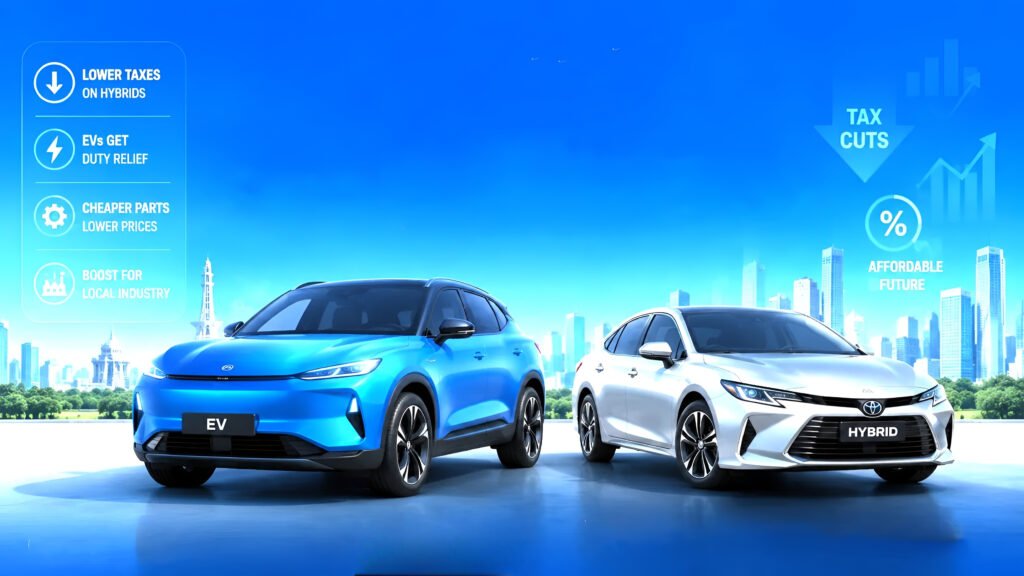
The government prepares to remove tax exemptions on electric and hybrid vehicles in the upcoming federal budget 2026-27. The International Monetary Fund rejects Pakistan’s request to maintain existing tax relief on these vehicle categories.
The Ministry of Industries and Production confirms the development. Officials now move forward with plans to impose a uniform 18 percent sales tax on both electric and hybrid vehicles. The decision marks a significant policy reversal for Pakistan’s green vehicle sector.
Massive Tax Jump Looms for EV and Hybrid Buyers
Currently, electric vehicles carry a concessional sales tax of just 1 percent. Hybrid vehicles face a reduced rate of 8 percent. The proposed budget eliminates both concessions.
The government plans to apply the standard 18 percent sales tax rate across both categories. This means electric vehicle buyers face an 1,700 percent increase in their tax rate. Hybrid vehicle buyers face a jump of more than 125 percent. Consumers and dealers react with alarm to the proposed shift.
The government also eyes solar panels for a tax increase. Officials consider raising solar panel sales tax from 10 percent to 18 percent. The move signals a broader rollback of green energy incentives across multiple sectors.
Prices to Rise on Imported and Local EVs
Officials confirm that removing exemptions will push vehicle prices sharply higher. Both imported and locally assembled hybrid and electric vehicles will become more expensive.
Importers warn that the cost increase will pass directly to consumers. Automakers currently investing in local EV assembly face fresh uncertainty. Industry representatives urge the government to reconsider the decision. They argue that the tax hike undermines years of policy work to promote cleaner transportation in Pakistan.
The timing raises concerns within the industry. Pakistan’s EV market remains in an early growth phase. High prices already limit adoption among middle-income buyers. A jump to 18 percent sales tax threatens to stall that growth completely.
EV Imports Show Steady Demand Despite Rising Costs
Import data reveals strong consumer interest in electric and hybrid vehicles despite existing cost pressures.
Pakistan imported approximately 45,000 electric and hybrid vehicles in the previous fiscal year. Current fiscal year estimates project around 40,000 units as costs rise and policy uncertainty grows. Between July and April of the current fiscal year alone, Pakistan imported nearly 38,000 vehicles. The figures demonstrate that demand remains resilient even under challenging conditions.
Industry analysts warn that the proposed 18 percent sales tax could significantly dent these numbers. Higher upfront costs may push buyers back toward conventional petrol and diesel vehicles. This outcome would contradict Pakistan’s stated goals of reducing fuel imports and cutting vehicle emissions. The government faces pressure from multiple sides as budget discussions intensify in the coming weeks.