
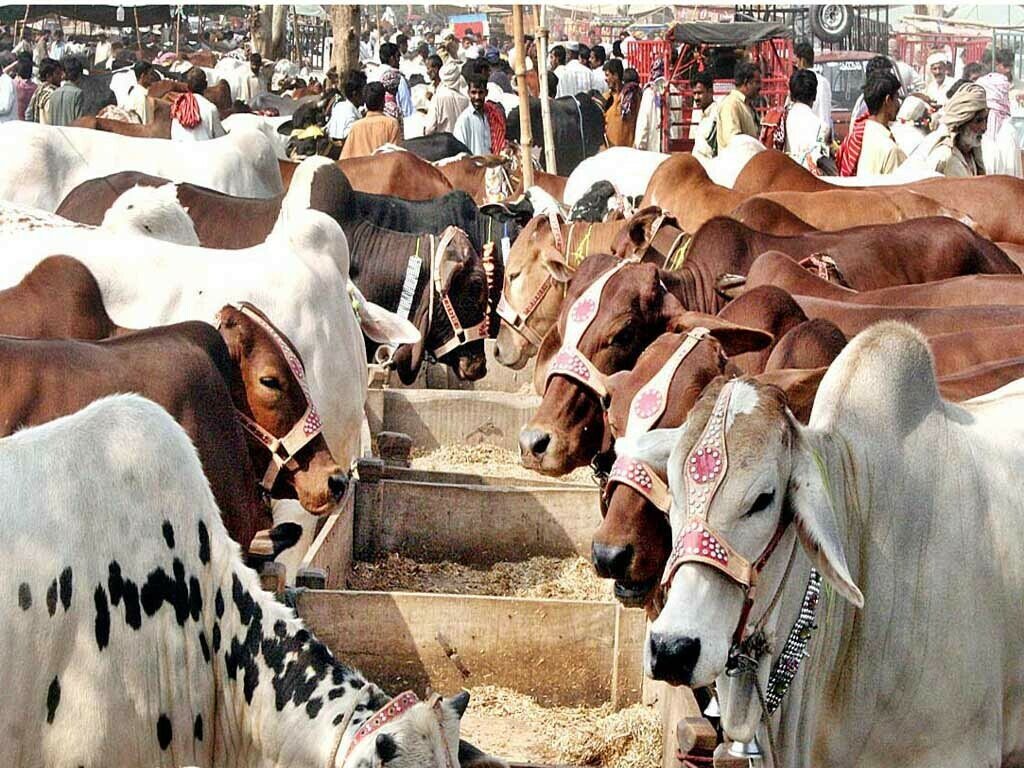
Karachi’s livestock markets begin buzzing with activity weeks before Eid al-Adha as traders bring cattle from Sindh, goats from Balochistan, and camels from various regions of the country. Beyond its religious significance, the annual qurbani ritual has evolved into one of Pakistan’s largest informal economic events.
Every year, millions of Pakistanis participate in qurbani during the three days of Eidul Azha. Estimates suggest nearly 7.4 million animals are sacrificed nationwide, generating economic activity worth between Rs539 billion and Rs752 billion. According to analysis by Ammar H Khan, the base estimate stands at approximately Rs641 billion.
This enormous private spending is equivalent to more than half of Pakistan’s annual federal development budget, despite operating entirely without formal government coordination. The system runs through religious obligation, household spending, and traditional market networks.
The economic impact becomes visible in data from the State Bank of Pakistan, which shows a sharp increase in currency circulation before Eid as cash transactions surge for animal purchases, transportation, fodder, and related services.
The livestock supply chain supports thousands of livelihoods. Farmers spend months raising animals using local fodder before traders transport them to urban cattle markets. Butchers, transporters, hide collectors, and mandi workers also earn significant income during the season.
An average cow sells for around Rs110,000, with farmers retaining nearly 55 to 65 percent of the proceeds after expenses. Analysts estimate that roughly Rs420 billion flows into rural households within a single week, creating a major rural-to-urban economic transfer.
Karachi alone reportedly spent around Rs185 billion on sacrificial animals in 2025, with more than two million animals traded in the city. Shared qurbani arrangements, where multiple families jointly purchase larger animals, also help middle-class households participate despite rising costs.
Beyond commerce, Eidul Azha also functions as a large-scale private food distribution system. Around 532,000 tonnes of meat are distributed during the festival, with nearly one-third traditionally shared with underprivileged families and communities. Experts note that this level of private redistribution often exceeds the scale of many government-led food support programs.
The annual event also highlights the size and importance of Pakistan’s informal economy, as many butchers, traders, transporters, and temporary workers earn a substantial portion of their yearly income during the Eid season. Despite its scale, much of this economic activity remains outside official statistics and formal documentation.